Do Freelancers in Pakistan Have to Pay Income Tax? (2026–27 Guide)
Yes, freelance income is taxable in Pakistan. Tax Year 2027 rates under Section 154A (0.25% PSEB IT, 1% others), filing rules, NTN and records to keep.
In this guide
- Are freelancers legally required to pay tax?
- How much income tax do freelancers pay?
- What is the 0.25% rate, and who qualifies?
- Do Upwork and Fiverr freelancers have to pay tax?
- What about freelancers working with Pakistani clients?
- Do freelancers need an NTN?
- Do freelancers need to file income tax returns?
- What records should freelancers keep?
- What happens if freelancers don’t pay tax?
- Is freelance income tax-free in Pakistan?
- Frequently asked questions
- Final thoughts
Freelancing has become one of the most popular ways to earn in Pakistan. Web designers, graphic designers, writers, digital marketers, virtual assistants and video editors now work with clients all over the world through platforms like Upwork, Fiverr and Freelancer.com.
Earning online raises an important question that many freelancers overlook: do freelancers in Pakistan have to pay income tax?
The short answer is yes. Freelance income is generally taxable and should be declared. How much you pay depends on the type of service, where your clients are, how you’re paid and whether you qualify for special tax treatment.
The good news is that Pakistan offers very low tax rates on exported services, especially IT and IT-enabled services. Understanding these rules helps you manage your income, avoid problems and stay compliant.
This guide explains the general rules for Tax Year 2027. It isn’t professional tax advice; for your specific situation, consult a qualified tax adviser.
Are freelancers legally required to pay tax?
Yes. Under the Income Tax Ordinance, 2001, freelance earnings are generally taxable income. Working for yourself doesn’t make your income tax-free. Whether you’re paid through Upwork, Fiverr, Payoneer, Wise or a direct bank transfer, Pakistani tax law can apply.
There’s an important distinction between earning from local clients and exporting services to international clients. Both can create tax obligations, but they’re treated differently. If you regularly work with foreign clients, understanding the export-of-services rules is essential.
How much income tax do freelancers pay?
A big reason Pakistan is attractive for freelancers is that qualifying exported services are taxed at a very low rate under Section 154A of the Income Tax Ordinance. Tax is deducted from qualifying export proceeds received through the banking system.
For Tax Year 2027 (1 July 2026 to 30 June 2027), the rates are:
| Type of freelance service | Tax rate |
|---|---|
| IT and IT-enabled services exported by PSEB-registered exporters | 0.25% |
| Other qualifying exported services | 1% |
The Finance Act 2026 extended the 0.25% rate for PSEB-registered IT and IT-enabled service exporters up to Tax Year 2029. It had previously been due to expire on 30 June 2026.
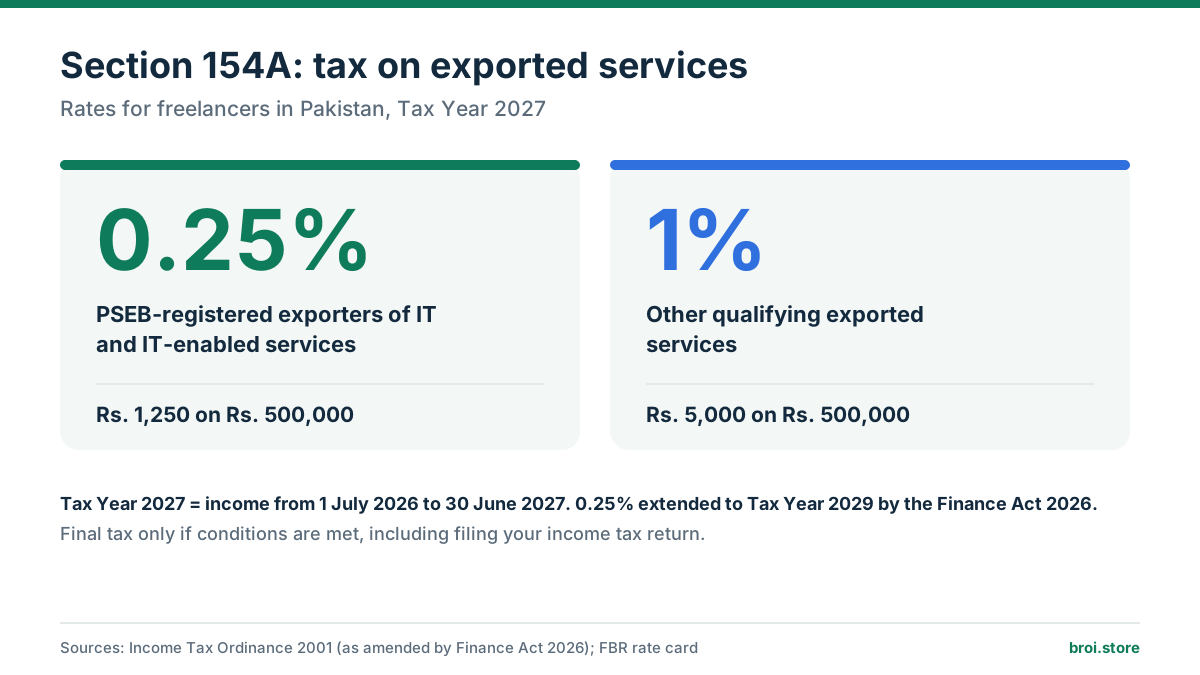
Here’s what that means in rupees for a freelancer who earns Rs. 500,000 from international clients:
| Rate | Tax deducted |
|---|---|
| 0.25% (PSEB-registered IT exporter) | Rs. 1,250 |
| 1% (other qualifying exports) | Rs. 5,000 |
These figures are deductions on qualifying export proceeds. To get this treatment, you must meet the legal conditions, which are explained below. You can estimate your own figures with the Pakistan Freelancer Tax Calculator.
What is the 0.25% rate, and who qualifies?
The 0.25% rate is one of the most attractive tax provisions for IT exporters in Pakistan. It exists to encourage software development, technology services and IT exports.
But not everyone who earns online qualifies automatically. The concession generally applies to exporters of computer software, IT services and IT-enabled services who are registered with the Pakistan Software Export Board (PSEB). Examples of relevant services include:
- Software development and programming
- Website development and web design
- Mobile app development
- Digital and graphic services that fall under IT-enabled services
- SEO and certain digital marketing services
- Cloud computing and related IT services
- Data processing and other qualifying IT services
The exact classification of your service matters. Calling yourself a “freelancer” or “digital professional” isn’t enough. Check your PSEB registration and service category before claiming the reduced rate. Our step-by-step guide to How to Register as a Freelancer with PSEB explains how to register.
Do Upwork and Fiverr freelancers have to pay tax?
Yes. Pakistani freelancers paid through international platforms such as Upwork and Fiverr are responsible for their own Pakistani tax obligations. These platforms connect you with clients, but they don’t handle your Pakistani income tax for you.
Take a Pakistani graphic designer on Fiverr who earns $800 from international clients. That income isn’t tax-free just because it came through Fiverr. The freelancer needs to check whether it qualifies as exported services and keep proper records of the payments.
The same applies on Upwork, Freelancer.com, PeoplePerHour or with direct international clients. Receiving money through Payoneer or Wise doesn’t decide your tax rate on its own. What matters is the nature of the service, how the income is classified and the payment records.
What about freelancers working with Pakistani clients?
Income from local clients is treated differently from exports. A web developer in Lahore building a website for a company in Karachi is working independently, but the service isn’t exported. That income is generally taxed as business income under the normal rules for individuals, and some Pakistani companies may deduct withholding tax when they pay you.
The reduced export rates are not a general exemption for all freelancers. Your tax treatment depends on the type of income and which provisions apply. We cover local-client income, social media earnings and the Active Taxpayer List in Tax on Local Clients, Social Media Income and ATL.
Do freelancers need an NTN?
A National Tax Number (NTN) is your identity in Pakistan’s tax system. Freelancers who need to register and file returns do so with the Federal Board of Revenue (FBR) through its online IRIS portal. For individuals, your 13-digit CNIC number serves as your NTN once you complete e-enrolment.
How to get started:
- Visit the FBR IRIS portal at iris.fbr.gov.pk and choose registration for individuals.
- Enter your details: CNIC, mobile number registered in your name, email and other required information.
- Complete registration and access your tax profile.
- Keep your financial records: invoices, bank statements and platform reports.
Getting an NTN doesn’t mean you’ve paid your taxes. Registering and filing returns are separate duties.
Do freelancers need to file income tax returns?
This is where many freelancers get caught out. Tax deducted is not the same as a tax return filed.
Some freelancers assume they don’t need to file because their bank already deducted tax on their international payments. That assumption can cause problems.
Section 114 of the Ordinance sets out who must file a return. And under Section 154A, export proceeds are treated as final tax only if certain conditions are met, including that you have filed your income tax return (and any required withholding statements). If you don’t meet these conditions, the reduced rate may not be treated as your final tax. That makes filing especially important for freelancers who want to benefit from the export rates.
The standard deadline for individuals to file is 30 September after the end of the tax year, although FBR sometimes extends it. Check FBR’s current announcements before you file.
What records should freelancers keep?
Good records are the easiest way to avoid tax headaches. Many freelancers receive payments from several clients and platforms during the year, and without documentation it’s hard to show where the money came from.
Keep these records:
- Bank statements showing incoming international payments
- Proceeds realisation certificates or equivalent bank records for foreign transfers
- Earnings reports from Upwork, Fiverr and other platforms
- Client invoices and payment receipts
- Payoneer or Wise transaction histories
- PSEB registration and certification documents, if applicable
- Records of business expenses and other relevant transactions
Keep your own consistent record of income too, instead of relying only on the balances shown in your payment accounts.
What happens if freelancers don’t pay tax?
Ignoring tax obligations can cause bigger problems as your income grows. FBR has the authority to identify people who haven’t met their obligations. Depending on the circumstances, non-compliance can lead to:
- Late filing penalties for people required to file who miss the deadline.
- Tax notices asking about your income, transactions or unexplained assets.
- Difficulty proving your income, for example when applying for financial services.
- Losing the benefit of reduced rates, because the export rates are only final when you meet the filing conditions.
Receiving international payments isn’t a problem in itself. What matters is keeping proper records and following the rules that apply to your income.
Is freelance income tax-free in Pakistan?
No. Freelance income isn’t automatically exempt. But Pakistan does give favourable treatment to certain exported services: a PSEB-registered IT freelancer can claim 0.25%, and other qualifying exported services are taxed at 1%.
Different rules may apply to income from local clients, or to services that don’t qualify for these concessions. There’s also an important difference between freelancing and remote employment. If you’re a full-time employee of a foreign company, don’t assume the export-of-services rules apply to your salary. Getting this right helps you avoid filing an inaccurate return.
Frequently asked questions
Do small freelancers in Pakistan have to pay income tax?
Small freelancers aren’t automatically exempt. Their obligations depend on their annual income, filing requirements and the nature of the income. Qualifying export services may still benefit from the low 154A rates.
Is Upwork income taxable in Pakistan?
Yes. Upwork income isn’t automatically tax-free. Declare it where required and check whether your services qualify for the export-of-services rates.
Is Fiverr income taxable in Pakistan?
Yes. The treatment depends on the services you provide and whether you qualify for a concession.
Can freelancers in Pakistan pay only 0.25% income tax?
PSEB-registered exporters of computer software, IT services and IT-enabled services can qualify for the 0.25% rate under Section 154A, provided they meet the conditions, including filing their return.
Do freelancers need to register with PSEB?
PSEB registration matters if you want the special 0.25% rate on qualifying IT and IT-enabled exports. Other freelancers may fall under different provisions. It isn’t mandatory for everyone who earns online.
Do I pay tax if I receive money through Payoneer?
Potentially, yes. Payoneer is a payment service, not a tax exemption. What matters is the source and nature of your income. Keep proper payment records.
What is Pakistan’s tax year?
It runs from 1 July to 30 June. Tax Year 2027 covers income earned between 1 July 2026 and 30 June 2027.
Can I file my income tax return myself?
Yes. Individuals can register and file through FBR’s IRIS portal. If your income situation is complex, professional advice can help.
Final thoughts
Freelancing gives Pakistanis a great opportunity to earn, build skills and work with international companies without leaving the country. But building a sustainable career takes more than finding clients and getting paid; understanding your tax responsibilities is just as important.
Whether you’ve just earned your first $100 on Fiverr or you’re an experienced developer with several international clients, good records and a clear understanding of the rules will save you trouble. Pakistan’s tax incentives for IT exporters are genuinely attractive, but they come with conditions: know whether you’re eligible, keep your documents and file your return.
Sources
Run your own numbers
Estimate Section 154A tax at 0.25% or 1%, and see what PSEB registration saves you.
Open the Pakistan Freelancer Tax Calculator