How to Register as a Freelancer or IT Exporter in Pakistan (PSEB) and Why It Matters
Step-by-step PSEB freelancer registration: FBR NTN, bank account, documents, the Rs. 1,000 fee, and how the 0.25% tax rate saves you money.
In this guide
- Why does freelancer registration matter?
- What is PSEB?
- Step 1: Register with FBR and get your NTN
- Step 2: Have a personal bank account
- Step 3: Register with PSEB
- How much does PSEB freelancer registration cost?
- Step 4: Tell your bank you’re an IT exporter
- Step 5: Use the foreign-currency retention facility
- How PSEB registration saves you money
- Can graphic designers, writers and marketers register?
- Individual freelancer or IT company?
- Common registration mistakes to avoid
- Frequently asked questions
- Final thoughts
Pakistan’s freelance industry is no longer a small group of people working online. Thousands of Pakistanis now provide software development, design, digital marketing, content and website development to clients around the world.
Earning from international clients is only one part of building a successful freelance career. It also pays to understand how to register your freelance business, receive foreign payments through the right banking channels and access government incentives.
Many Pakistani freelancers work on Upwork, Fiverr and Freelancer.com without ever registering with a government body. Some don’t know they can get official recognition as freelancers; others assume registration is only for large software companies. In fact, individual freelancers can register with the Pakistan Software Export Board (PSEB) if they meet the requirements.
Registration can give you access to a lower tax rate, create a formal financial record, make receiving international payments smoother and connect you to Pakistan’s growing IT export industry. Here’s how to do it.
Why does freelancer registration matter?
Freelancing brings foreign currency into Pakistan, creates jobs and lets skilled people work with international companies without moving abroad. It’s growing fast: Pakistani freelancers earned a record $1.76 billion in export income in FY2025-26, up 78% on the previous year, according to the Finance Ministry. That’s why the government supports freelancers through PSEB registration, dedicated banking arrangements and lower tax for qualifying IT exporters.
For an individual freelancer, registration offers several practical benefits.
Lower tax on eligible IT exports. The biggest reason to register. PSEB-registered freelancers can qualify for a 0.25% tax rate on eligible IT and IT-enabled export income, compared with 1% for other qualifying exported services. The Finance Act 2026 extended the 0.25% rate up to Tax Year 2029.
Official recognition. PSEB issues a membership certificate confirming you’re part of Pakistan’s IT and IT-enabled services industry.
Better financial records. Registered freelancers tend to keep organised records of their international income, banking transactions and export proceeds.
Access to support programmes. PSEB runs industry support, training and facilitation programmes for registered IT professionals.
Professional credibility. Formal registration helps you show your status to banks, institutions and international partners.
What is PSEB?
The Pakistan Software Export Board (PSEB) is a government body under the Ministry of Information Technology and Telecommunication. Its job is to promote Pakistan’s IT and IT-enabled services industry, grow software and technology exports and support Pakistani tech professionals. It runs an online registration system through which individual freelancers can become members.
PSEB registration is not the same as registering a company with the Securities and Exchange Commission of Pakistan (SECP). You don’t need to set up a private limited company to get PSEB freelancer membership. For most independent professionals, individual freelancer registration is enough.
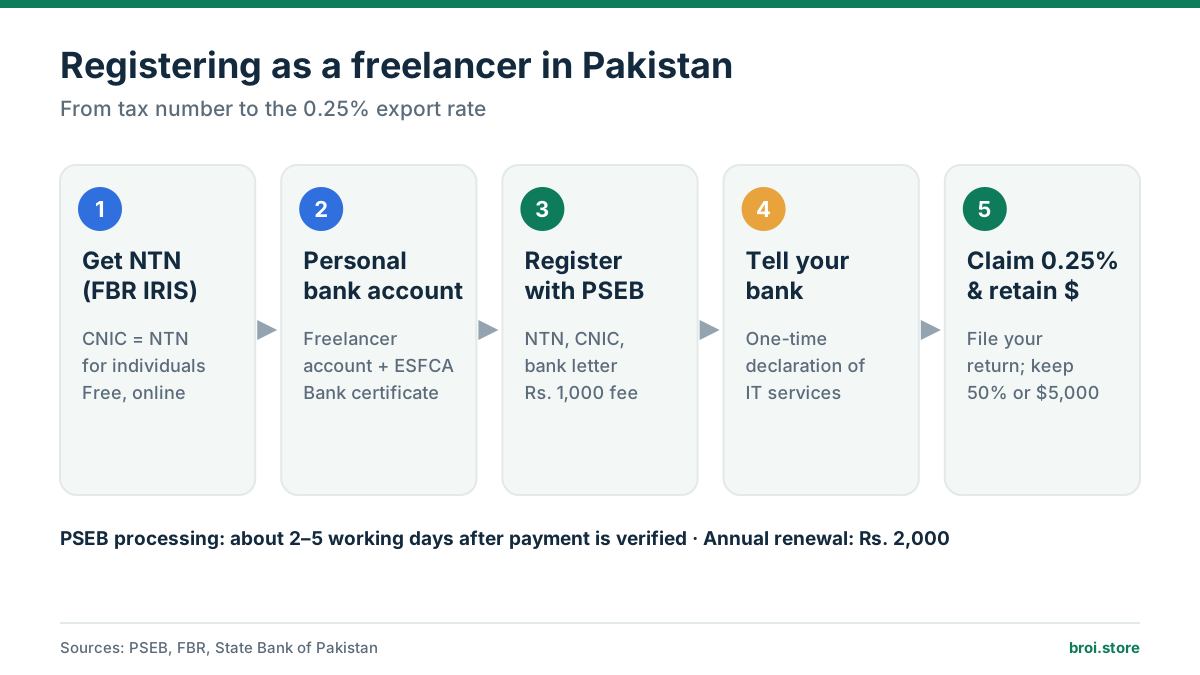
Step 1: Register with FBR and get your NTN
Start with the Federal Board of Revenue (FBR). For individuals, your 13-digit CNIC number becomes your NTN once you complete e-enrolment. You don’t need a company to get one, and you can do it all online through the IRIS portal.
Prepare these before you start:
- Your valid CNIC
- A mobile number registered against your own CNIC
- Your personal email address
- Your personal bank account details
- If you have business premises: proof of ownership or tenancy and a recent utility bill
How to register:
- Go to the official IRIS portal at iris.fbr.gov.pk and start registration for individuals.
- Enter your CNIC, mobile number, email and bank details.
- Complete the required fields and submit.
- Once e-enrolment succeeds, you can access your tax profile. Your CNIC is your NTN.
Getting an NTN doesn’t mean you’ve met all your tax obligations. You still need to file income tax returns where the law requires; see Do Freelancers in Pakistan Pay Income Tax?.
Step 2: Have a personal bank account
PSEB’s individual freelancer category requires a personal NTN without a business name and a personal bank account in your own name. If you already have one, ask your bank for an account maintenance certificate or bank letter.
If you don’t, visit a Pakistani bank and ask about its freelancer banking options.
What is a freelancer account?
On 23 October 2023, the State Bank of Pakistan issued a Framework for Freelancers Accounts. Under it, freelancers can open a primary PKR account together with an Exporters’ Special Foreign Currency Account (ESFCA), in person or remotely. This lets you receive foreign payments and keep part of your export earnings in foreign currency, which makes managing regular international income much easier.
Step 3: Register with PSEB
Once you have an NTN and a personal bank account, apply for PSEB freelancer membership online through PSEB’s registration portal at techdestination.com.
Documents required (individual freelancer):
- Personal NTN (without a business name)
- CNIC copy, front and back
- Personal bank account maintenance certificate or bank letter
Make sure your scans are clear and your details match your FBR profile and bank records. Incomplete applications or mismatched information are the most common causes of delay.
How to apply:
- Create an account on the PSEB freelancer registration portal. Your login details arrive by email.
- Fill in the registration form with your personal details and the IT or IT-enabled services you provide.
- Upload your documents: CNIC, NTN details and bank certificate.
- Submit for initial approval. PSEB reviews your application and may return it if something is missing.
- Pay the registration fee through the portal’s payment gateway or by pay order/demand draft, and upload proof of payment if required.
- Download your certificate once final approval is granted.
PSEB’s published guidance says processing usually takes 2 to 5 working days after payment is verified, as long as your application and documents are complete.
How much does PSEB freelancer registration cost?
Individual freelancer registration is very affordable. According to PSEB’s published fee schedule:
| Registration type | Fee |
|---|---|
| New freelancer registration | Rs. 1,000 |
| Annual renewal | Rs. 2,000 |
These are freelancer membership fees, not company registration fees. Government fees can change, so check the official portal before paying. For renewal, PSEB may also ask for a summary of your export income and your previous year’s income tax return.
Step 4: Tell your bank you’re an IT exporter
Getting your PSEB certificate is a big step, but there’s one more practical thing many freelancers skip: telling your bank that you receive export payments for IT or IT-enabled services.
When a client pays you for software development, web development or another qualifying digital service, the bank needs to record the payment as an export of services using the correct purpose code. That documentation can matter when you claim the 0.25% rate.
Take your PSEB certificate to your bank, explain the nature of your freelance services and ask them to set up your account correctly for IT export receipts.
2026 update: simpler export paperwork
In April 2026, the State Bank of Pakistan simplified export documentation for IT exporters and freelancers:
- You no longer need to submit Form R for every export transaction. It’s now required only for receipts above USD 25,000.
- Instead, you give a one-time declaration describing your services when opening an account, or when your bank asks for existing accounts.
- Banks assign the relevant service and purpose code to your account.
- Inward export receipts and outward remittances from ESFCAs must be processed within one working day.
This cuts down the recurring paperwork for freelancers who receive international payments regularly.
Step 5: Use the foreign-currency retention facility
SBP’s rules let IT exporters and freelancers keep part of their export earnings in foreign currency. SBP raised the limit from 35% to 50% in 2023, and IT exporters and freelancers can now keep the higher of 50% of export proceeds or USD 5,000 per month in their ESFCA.
You can use these retained funds for permitted current-account payments abroad without SBP’s prior approval, for example:
- Software subscriptions
- International digital services
- Professional memberships
- Online certifications
- Work-related digital advertising
This is useful because freelancers often have international business expenses. Instead of converting every dollar to rupees and then buying dollars again later, you can keep part of your earnings for permitted spending. Confirm the exact account and documentation requirements with your bank. Whether to convert or hold is covered in Convert Your Dollars or Hold Them?.
How PSEB registration saves you money
Imagine a Pakistani web developer with Rs. 1,000,000 of qualifying IT export proceeds.
With PSEB registration at 0.25%: Rs. 1,000,000 × 0.25% = Rs. 2,500
At the general 1% rate: Rs. 1,000,000 × 1% = Rs. 10,000
That’s a saving of Rs. 7,500 for every Rs. 1 million of eligible export proceeds, for a Rs. 1,000 registration fee.
| Annual export proceeds | Tax at 0.25% | Tax at 1% | You save |
|---|---|---|---|
| Rs. 500,000 | Rs. 1,250 | Rs. 5,000 | Rs. 3,750 |
| Rs. 1,000,000 | Rs. 2,500 | Rs. 10,000 | Rs. 7,500 |
| Rs. 2,000,000 | Rs. 5,000 | Rs. 20,000 | Rs. 15,000 |
| Rs. 5,000,000 | Rs. 12,500 | Rs. 50,000 | Rs. 37,500 |
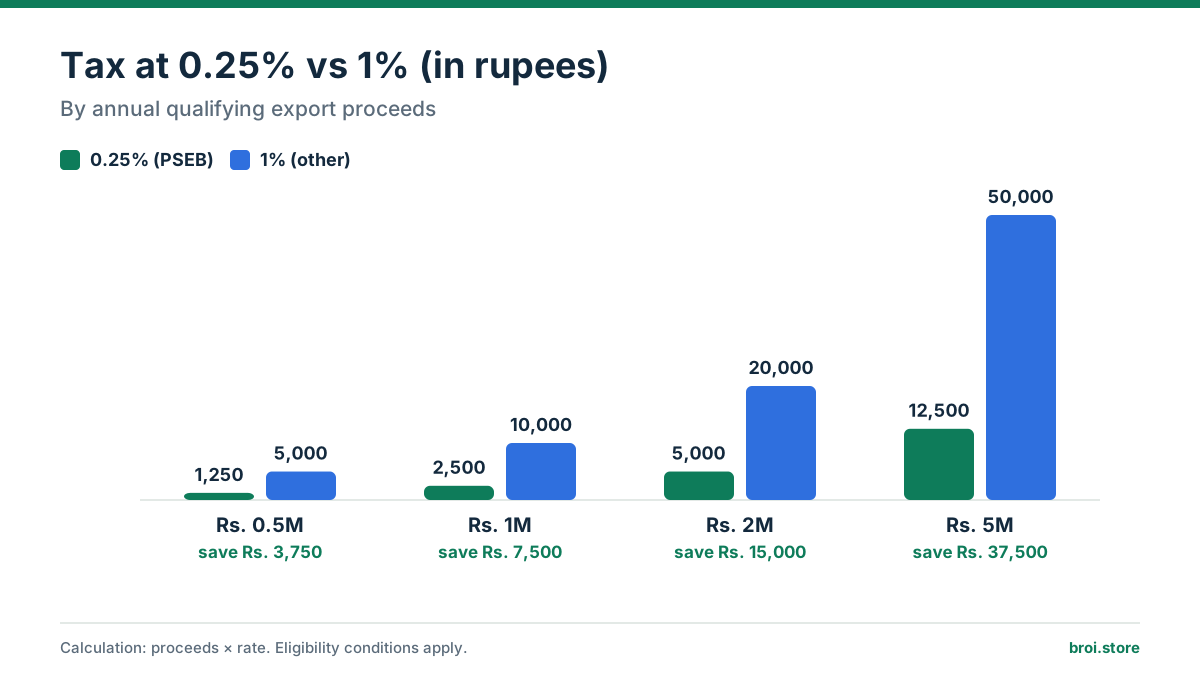
The 0.25% rate depends on PSEB registration, an eligible service category and meeting the tax law’s conditions, including filing your return. Not every type of freelance income qualifies. Try your own numbers in the Pakistan Freelancer Tax Calculator.
Can graphic designers, writers and marketers register?
Not everyone who works online is a software developer, so this is a fair question.
PSEB freelancer membership is for self-employed people providing IT and IT-enabled services. Software developers, web developers, mobile app developers and professionals providing technology-related digital services are the clearest fit.
However, someone offering general content writing, traditional graphic design, admin support or other online services shouldn’t assume their work automatically qualifies for the IT exporter concession. Service classification is essential. If your work spans several categories, check with PSEB and your bank which of your services qualify before applying.
Individual freelancer or IT company?
Not every freelancer needs a registered company. The right route depends on how you operate.
| Feature | Individual freelancer | IT company |
|---|---|---|
| Business structure | Individual | Sole proprietorship, partnership or company |
| NTN | Personal NTN | Business NTN |
| Bank account | Personal account | Business account |
| PSEB category | Freelancer membership | Company registration |
| Suitable for | Independent professionals | Formal IT businesses and teams |
If you work independently on Upwork or Fiverr under your own name, the individual freelancer route is usually right. If you operate through a business with its own NTN, look at PSEB’s company registration category instead.
Common registration mistakes to avoid
Using incorrect NTN details. Make sure your NTN details match your CNIC and FBR profile.
Uploading incomplete documents. Upload both sides of your CNIC and a readable bank certificate.
Using the wrong bank account. The individual category needs a personal account in your own name, not a business account or someone else’s.
Assuming every online service gets 0.25%. The reduced rate applies to eligible IT and IT-enabled exports. PSEB membership alone doesn’t make all income eligible.
Ignoring tax returns. FBR and PSEB registration don’t replace your duty to file returns.
Not informing your bank. Your bank needs to know your international payments are service exports so they’re classified correctly.
Frequently asked questions
Can I register as a freelancer in Pakistan without a company?
Yes. PSEB offers an individual freelancer membership category. Eligible people can apply with their personal NTN and personal bank account without setting up a company.
How much does freelancer registration cost?
PSEB’s published fee is Rs. 1,000 for new freelancer registration and Rs. 2,000 for annual renewal.
Do I need an NTN for PSEB registration?
Yes. Individual freelancer membership requires a valid personal NTN without a business name. For individuals, this is your CNIC number after FBR e-enrolment.
How long does PSEB registration take?
PSEB’s guidance says about 2 to 5 working days after payment verification, if your application and documents are complete.
Can Upwork and Fiverr freelancers register with PSEB?
Yes, if their services and documents meet PSEB’s requirements. Freelancers on Upwork, Fiverr, Freelancer.com, Toptal and similar platforms can apply.
Does PSEB registration guarantee the 0.25% tax rate?
No. The reduced rate applies to eligible IT and IT-enabled export proceeds and depends on meeting the legal conditions, including filing your return.
Can I receive international payments without PSEB registration?
Yes. You can receive payments through banks and payment services without PSEB registration, but you won’t get the 0.25% rate available to registered IT exporters.
Can I keep my freelance income in US dollars?
Yes, partly. Freelancers can keep the higher of 50% of export proceeds or USD 5,000 per month in an Exporters’ Special Foreign Currency Account, under current SBP rules.
Is PSEB registration compulsory?
No. It’s a voluntary membership, not a legal requirement for everyone who earns online. But eligible IT freelancers often find it worthwhile for the tax concession and industry support.
Final thoughts
Freelancing is becoming an important source of income for people and of foreign exchange for Pakistan. A sustainable career, though, takes more than an Upwork or Fiverr account. FBR registration, PSEB membership where appropriate and the right bank account can make your freelance business more professional.
The process isn’t complicated. Most independent IT freelancers can start with a personal NTN, a personal bank account and the PSEB documents listed above. And for eligible IT exporters, the 0.25% rate can mean real savings. If you earn steadily from international clients, it’s worth sorting this out now rather than waiting until your business grows.
Sources
- PSEB: Freelancer registration portal
- FBR IRIS portal
- State Bank of Pakistan: BPRD Circular No. 5 of 2023, Framework for Freelancers Accounts
- State Bank of Pakistan: FE Circular Letter 17 of 2023, Annexure A (ESFCA retention)
- State Bank of Pakistan: Press release, 6 April 2026
- Arab News: Pakistan records $1.76 billion freelancer export earnings in FY2025-26
- BACO Consultants: PSEB registration 2026 (fees and tax rate extension)
Run your own numbers
Estimate Section 154A tax at 0.25% or 1%, and see what PSEB registration saves you.
Open the Pakistan Freelancer Tax Calculator