Freelancer Tax Beyond Exports: Local Clients, YouTube and TikTok Income, and the Active Taxpayer List
How Pakistani freelancers are taxed on local clients, YouTube/TikTok income under new Section 154B (5% or 10%), and why the Active Taxpayer List matters.
In this guide
- Three kinds of freelance income, three sets of rules
- Income from Pakistani clients
- YouTube, TikTok and other social media income
- What is the Active Taxpayer List?
- What records should you keep?
- Why file a return even if tax was already deducted?
- Common tax mistakes freelancers make
- Frequently asked questions
- Final thoughts
Most tax guides for Pakistani freelancers focus on one thing: the low 0.25% and 1% rates on exported services under Section 154A. If all your income comes from foreign clients, our main guide, Do Freelancers in Pakistan Pay Income Tax?, covers what you need.
But many freelancers earn from more than one source. You might build websites for a Karachi company, sell on Fiverr and earn AdSense revenue from a YouTube channel. Each of those can fall under different tax rules. This guide covers the income streams the export rules don’t: local clients, social media earnings and why being on FBR’s Active Taxpayer List (ATL) matters.
This is general information for Tax Year 2027, not professional tax advice. Tax rules change with each Finance Act, so check current FBR guidance or consult a tax professional for your situation.
Three kinds of freelance income, three sets of rules
| Income source | Main provision | Rate / treatment |
|---|---|---|
| Services exported to foreign clients | Section 154A | 0.25% (PSEB-registered IT exporters) or 1%, final tax if conditions are met |
| Services for Pakistani clients | Normal business income rules; withholding may apply (e.g. Section 153) | Taxed under normal slab rules for individuals |
| Social media platform payments (YouTube, TikTok etc.) | Section 154B (new from Finance Act 2026) | 5% if on the ATL, 10% if not; minimum tax for residents |
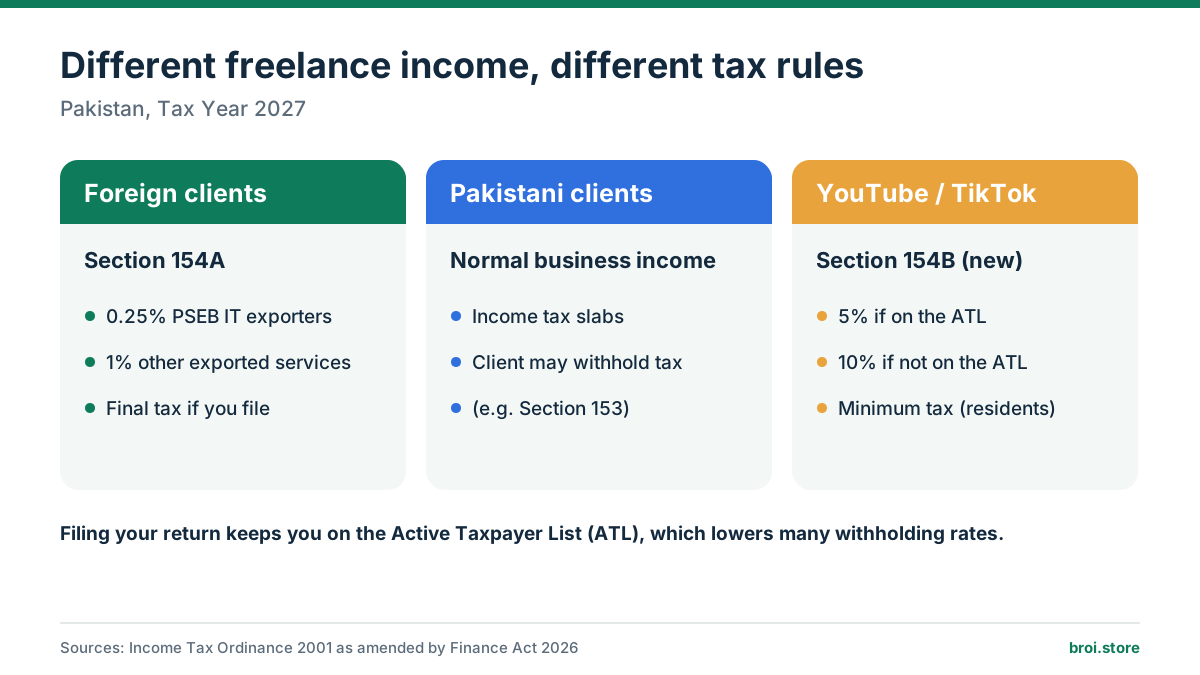
The most common mistake is applying the export rate to everything. Let’s look at each type.
Income from Pakistani clients
When you work for a client inside Pakistan, you aren’t exporting a service, even if the work is done entirely online. A web developer in Lahore building a site for a Karachi company, a designer working for a Pakistani brand or a writer serving local businesses all earn domestic income.
That income is generally treated as business income and taxed under the normal rules for individuals, which means your total taxable income for the year goes through the income tax slabs. The low Section 154A rates don’t apply to it.
Some Pakistani companies are also required to deduct withholding tax when they pay for services (for example under Section 153). The rate depends on the type of service and the payer. If tax is deducted, ask the client for a withholding certificate and keep it, because you may be able to claim it when you file your return.
Practical tips:
- Invoice local and foreign clients separately so the two income types are easy to tell apart.
- Keep withholding tax certificates from local clients.
- Don’t leave local income out of your return just because you also have export income.
YouTube, TikTok and other social media income
Monetisation income from social media platforms isn’t the same as freelance client work, and since the Finance Act 2026 it has its own rule.
Section 154B introduces a withholding tax on payments that people receive from social media and digital platforms such as YouTube and TikTok. For Tax Year 2027 the rates are:
| Status | Rate |
|---|---|
| On the Active Taxpayer List (ATL) | 5% |
| Not on the ATL | 10% |
For residents, this is a minimum tax, so it isn’t simply a credit you can reduce later. It’s separate from the export-of-services treatment under Section 154A.
That means a freelancer who earns from client projects and from a YouTube channel may face two different tax treatments in the same year. If you create content as well as freelance, track platform revenue separately from client income.
If you earn platform revenue, notice the gap between 5% and 10%. Being on the ATL halves the rate. That’s one of the clearest examples of why the ATL matters.
What is the Active Taxpayer List?
The Active Taxpayer List (ATL) is FBR’s list of people who have filed their income tax return. It’s updated regularly, and you can check your status on FBR’s website or by SMS.
In practice, you’re on the ATL if you file your return by the due date (usually 30 September). If you file late, you can generally still be added, but you may need to pay a surcharge.
NTN is not the same as ATL
Many freelancers believe that having an NTN makes them a “filer”. It doesn’t. An NTN only means you’re registered with FBR. You appear on the ATL only after you file a return.
Why ATL status matters for freelancers
- Lower withholding rates. Many withholding taxes in Pakistan are significantly higher, often around double, for people not on the ATL. Section 154B (5% vs 10%) is one example.
- Final tax on exports. The low Section 154A rates on export income are treated as final tax only if you’ve filed your return. Filing protects the benefit of 0.25% or 1%.
- Claiming credits. Filing a return lets you claim credit for eligible tax already deducted, such as withholding by local clients.
- Financial credibility. Declared income helps when you apply for bank accounts, loans, visas or other financial services.
What records should you keep?
With more than one income stream, good records are essential. Keep:
- Platform earnings reports from Upwork, Fiverr and others
- Invoices for both local and international clients
- Bank statements showing incoming payments
- Payoneer, Wise or other payment provider histories
- Withholding tax certificates from Pakistani clients
- Social media platform payment statements
- PSEB registration documents, if applicable
- Records of business expenses
These help you show where each payment came from, which rule applies and how much tax has already been deducted.
Why file a return even if tax was already deducted?
Filing isn’t just about paying tax; it’s how you protect your position.
- Final-tax treatment: your export income is only taxed at the low final rate if you file.
- ATL status: being on the list reduces withholding on other transactions.
- Credits and refunds: filing is how you claim tax already deducted.
- Clear financial history: declared income makes your earnings easy to prove.
Common tax mistakes freelancers make
- Assuming online income is tax-free. It isn’t.
- Thinking Payoneer or another payment service removes tax obligations. Payment method doesn’t change your income’s tax treatment.
- Applying the export rate to local clients. Domestic income follows normal rules.
- Reporting only foreign income and leaving out local earnings.
- Assuming an NTN makes you an active taxpayer. You must file to be on the ATL.
- Treating YouTube or TikTok income as freelance service income without checking Section 154B.
- Not filing because tax was already deducted. That can cost you final-tax treatment and ATL status.
- Mixing personal and business transactions without keeping records.
The key is understanding how each source of income is treated, rather than applying one rule to every payment.
Frequently asked questions
Is income from Pakistani clients taxed at 0.25% or 1%?
No. Those Section 154A rates apply to exported services. Income from clients in Pakistan is generally taxed as normal business income, and the client may deduct withholding tax.
How is YouTube income taxed in Pakistan?
From Tax Year 2027, Section 154B applies a withholding tax of 5% for people on the Active Taxpayer List and 10% for others, on payments from social media platforms. For residents, it’s a minimum tax.
Am I a filer if I have an NTN?
No. An NTN means you’re registered. You become an active taxpayer and appear on the ATL only after filing your income tax return.
How do I check if I’m on the Active Taxpayer List?
You can check your ATL status on FBR’s website or through FBR’s SMS service using your CNIC number.
What if I miss the 30 September deadline?
You can usually still file late, but you may face penalties and need to pay a surcharge to be added to the ATL. Filing on time is cheaper and protects your export final-tax treatment.
Final thoughts
As freelancers’ online income grows, tax needs to be taken seriously. If you work with foreign clients, the export rates under Section 154A are very favourable. But income from Pakistani clients and from social media platforms follows different rules, and being on the Active Taxpayer List makes a real difference to how much tax is deducted.
Keep accurate records for each income stream, understand which rule applies to which payment and file your return on time. Tax rules change with every annual Finance Act, so review the latest FBR guidance or speak to a qualified tax adviser before making decisions about your tax position.
Sources
Run your own numbers
Estimate Section 154A tax at 0.25% or 1%, and see what PSEB registration saves you.
Open the Pakistan Freelancer Tax Calculator