Should You Convert Your Dollars Immediately or Hold Them?
Should Pakistani freelancers convert dollars to rupees right away or hold them? The trade-offs, what USD/PKR really did in 2026, and a balanced approach.
In this guide
- Why this decision matters
- Option 1: Convert your dollars immediately
- Option 2: Hold some dollars instead of converting everything
- What actually happened in 2026
- Example: how the exchange rate changes the outcome
- A balanced approach: convert what you need, hold the rest
- Exchange rates vs. the rate you actually get
- Questions to ask before holding foreign currency
- Don’t treat holding dollars as a guaranteed investment
- Frequently asked questions
- Final thoughts
For Pakistani freelancers with international clients, US dollar payments are a big part of their income. Upwork, Fiverr and direct foreign clients all pay in foreign currency. But once the money arrives, you face another decision: convert your dollars into rupees immediately, or hold them for a while?
There’s no answer that suits every freelancer. The right choice depends on your monthly spending, your savings goals, exchange-rate movements and which currency you actually spend. Understanding both options helps you manage international income more effectively.
Why this decision matters
Most freelancers in Pakistan spend in rupees: rent, food, electricity, transport and household costs are all paid locally. But international clients pay in dollars or other foreign currencies. That creates a gap between the currency you earn and the currency you spend.
If a client pays you $1,000 and the exchange rate is PKR 277 per dollar, the gross value is PKR 277,000. The rupees you actually receive may be lower because of conversion rates, withdrawal fees, intermediary charges and bank fees (see How Currency Conversion Eats Your Earnings). And when you convert also changes how many rupees you get.
Option 1: Convert your dollars immediately
Converting your income into rupees as soon as it arrives is the simplest approach. For freelancers who depend on that money for monthly bills, it’s often the most practical.
Advantages:
- You know exactly how many rupees you have.
- You can pay your bills without worrying about future exchange-rate moves.
- You aren’t exposed to the dollar weakening against the rupee.
- Your monthly budget stays predictable.
- You avoid speculating on exchange-rate improvements.
If your essential monthly expenses are Rs. 100,000 and you need the money for bills, converting enough to cover them gives you certainty.
The possible downside: if the dollar strengthens after you convert, you’d have received more rupees by waiting. But exchange rates move both ways, and there’s no guarantee that waiting will pay off.
Option 2: Hold some dollars instead of converting everything
Some freelancers keep part of their international earnings in US dollars. That can make sense when you don’t need all the money in rupees right away, or when you have future costs in foreign currency.
Advantages:
- You keep some exposure to the US dollar.
- You choose when to convert.
- Dollars are useful for future international payments or business costs, such as software, hosting and subscriptions.
- You avoid converting money you don’t need in rupees, only to convert it back later.
A freelancer who receives $1,500 might convert only what’s needed for monthly expenses and keep the rest in a permitted foreign-currency account. In Pakistan, freelancers can keep the higher of 50% of export proceeds or USD 5,000 per month in an Exporters’ Special Foreign Currency Account (ESFCA) under SBP rules (see How to Receive Freelance Payments in Pakistan).
The possible downside: holding dollars doesn’t guarantee a profit. If the dollar weakens against the rupee, converting later gives you fewer rupees. Account fees, terms and banking rules also apply.
What actually happened in 2026
Many freelancers hold dollars because they expect the rupee to keep losing value. Sometimes it does. But 2026 is a useful reminder that it isn’t guaranteed.
According to daily market data, USD/PKR peaked at about 282.8 in early January 2026 and fell to around 276.7 by late October, the year’s lowest range.
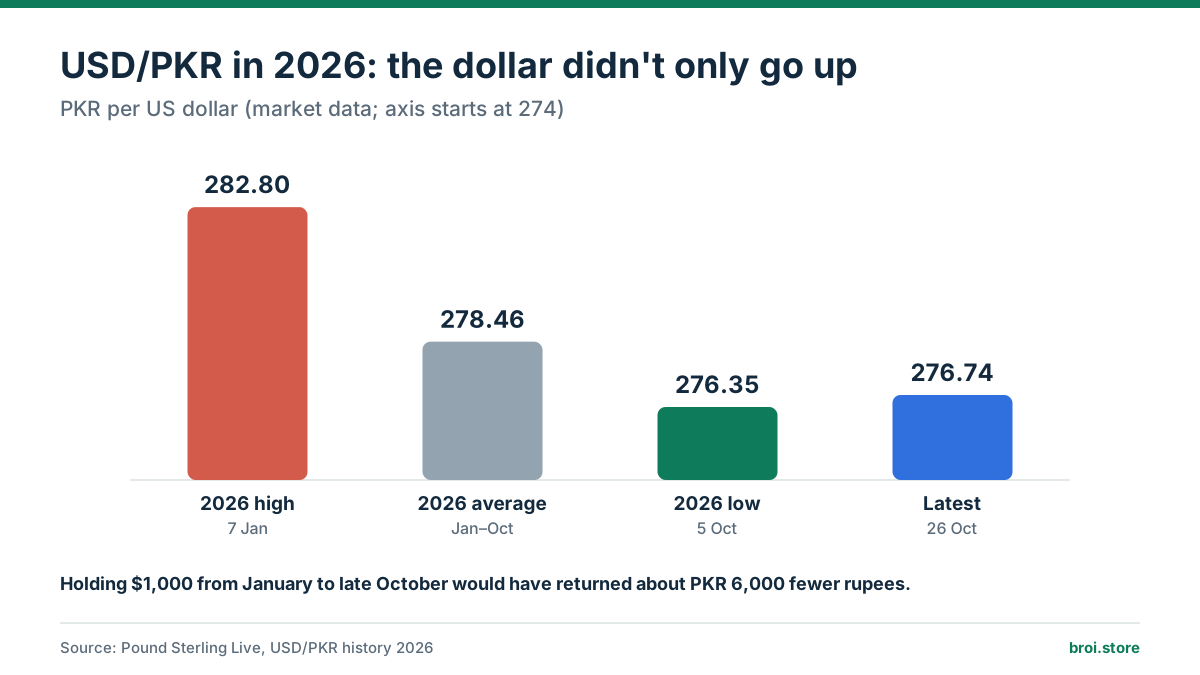
A freelancer who held $1,000 from January to October instead of converting would have received roughly PKR 6,000 fewer ($1,000 × (282.8 − 276.7)), before fees. Not a disaster, but it shows that holding dollars is a decision with risk, not a guaranteed gain.
Example: how the exchange rate changes the outcome
A client pays you $1,000. You can convert now or hold and convert later. Here’s what $1,000 is worth at different hypothetical rates:
| Exchange rate | Value of $1,000 |
|---|---|
| PKR 272 | PKR 272,000 |
| PKR 277 | PKR 277,000 |
| PKR 282 | PKR 282,000 |
| PKR 287 | PKR 287,000 |
If you convert at PKR 277 and the rate later rises to PKR 282, you’d have received PKR 5,000 less than if you had waited. If the rate falls to PKR 272, waiting would have cost you PKR 5,000.
Holding dollars isn’t automatically better. The result depends entirely on the rate when you finally convert.
A balanced approach: convert what you need, hold the rest
For many freelancers, the most practical strategy is neither to convert everything immediately nor to hold every dollar indefinitely. Instead, divide your foreign income according to what it’s for. If you receive $1,000:
- Monthly living costs: convert enough for rent, food, bills and other essentials.
- Business costs: keep dollars for software, hosting, advertising and other costs you pay in dollars; convert what you pay in rupees.
- Emergency savings: keep in an account that’s easy to access, with a level of currency risk you’re comfortable with. See How Much Emergency Savings Does a Freelancer Need?.
- Long-term savings: decide based on your future goals whether to hold foreign currency or convert.
Your exact split depends on your circumstances. Someone with plenty of rupee savings has more flexibility; a freelancer who needs most of their income for household costs will convert a larger share.
Exchange rates vs. the rate you actually get
A common mistake is comparing your payment with the rate you see on Google or a financial website. That market rate usually isn’t what your bank or payment provider gives you. Your actual conversion depends on:
- The rate offered by your bank or payment service
- Currency conversion fees
- Withdrawal charges
- Intermediary bank deductions
- How your client pays
- When the transaction happens
So compare the amount you receive, not just the quoted rate. Before deciding, check the current withdrawal and conversion costs with Payoneer, your bank or other provider. The Payment Method Comparison Calculator helps you compare options.
Questions to ask before holding foreign currency
Do I need this money soon? If rent, bills or other essentials are due, converting what you need is usually more sensible than taking on exchange-rate risk.
Do I already have emergency savings? If not, building an accessible emergency fund should come first.
Will I spend dollars in future? If you regularly pay for international software or services, holding some foreign currency can save you converting back and forth.
Can I handle exchange-rate swings? If a move in the rate would seriously hurt your finances, a large foreign-currency balance may not be right for you.
Are there account restrictions or fees? Check your bank’s rules, account terms and transaction costs first.
Don’t treat holding dollars as a guaranteed investment
Exchange rates can move significantly, and they’re hard to predict. Politics, the economy, central bank policy and global markets all affect them. Holding dollars can help diversify your currency exposure, but it shouldn’t be treated as a guaranteed way to make money. Your main goals should be to manage your income, meet your obligations and protect your savings.
Frequently asked questions
Is it smart to keep my freelance earnings in dollars?
Holding part of your earnings in dollars can make sense for dollar expenses or diversification, but it carries exchange-rate risk. In 2026, the rupee actually strengthened slightly against the dollar.
How much of my income can I keep in dollars in Pakistan?
Through an ESFCA, freelancers can retain the higher of 50% of export proceeds or USD 5,000 per month, subject to SBP rules and your bank’s terms.
When is the best time to convert dollars to rupees?
Nobody can reliably predict the best day. A simple, low-stress approach is to convert what you need on a regular schedule and avoid trying to time the market with money you need for bills.
Final thoughts
Whether you convert your dollars immediately or hold them depends on your financial situation. Converting gives you certainty and makes it easier to cover costs in Pakistan. Holding dollars gives flexibility and foreign-currency exposure, but with exchange-rate risk.
For many freelancers, a balanced approach makes the most sense: convert enough for regular expenses, keep accessible savings, and hold only the foreign currency you can afford to keep. The goal isn’t to predict the perfect exchange rate. It’s to make sure your freelance income meets your needs today while you prepare for the future.
Sources
Run your own numbers
Find a safe salary from uneven income and how long your emergency fund will take.
Open the Freelancer Budget & Emergency Fund Calculator