How to Receive Freelance Payments in Pakistan: Every Option Compared
Upwork Direct to Local Bank, Payoneer, SWIFT, Wise and freelancer accounts compared for Pakistan, with fees, limits and the 2026 SBP rule changes.
In this guide
- First, identify how your client pays you
- The main options compared
- Upwork Direct to Local Bank
- Payoneer
- Direct bank transfer through SWIFT
- Wise: what Pakistani residents need to know
- Open a Pakistani freelancer bank account
- Fiverr and other marketplace payouts
- Example: receiving $500 in Pakistan
- Which method should you choose?
- Checklist before accepting payment
- Frequently asked questions
- Final thoughts
Landing your first international client is a big milestone. The next challenge is getting paid reliably, without unnecessary deductions or banking headaches.
For freelancers in Pakistan, the right payment method depends on where you found the client, whether you work through a marketplace, how much you earn and whether you want rupees straight away or want to keep some income in foreign currency.
There’s no single best method for everyone. A freelancer earning on Upwork has different options from a developer working directly for a US company. A designer receiving $100 has different priorities from an agency receiving $5,000 a month. This guide compares the main options and helps you choose a practical setup.
First, identify how your client pays you
You work through a marketplace such as Upwork or Fiverr. Start with the platform’s official withdrawal methods for Pakistan: their fees, minimums and requirements.
You work directly with a foreign client. You might be paid through Payoneer, an international bank transfer or another supported service. Agree on the payment method, and on who covers transfer costs, before the project starts.
You receive regular export income. Ask your bank about a freelancer account and the foreign-currency retention options allowed by the State Bank of Pakistan.
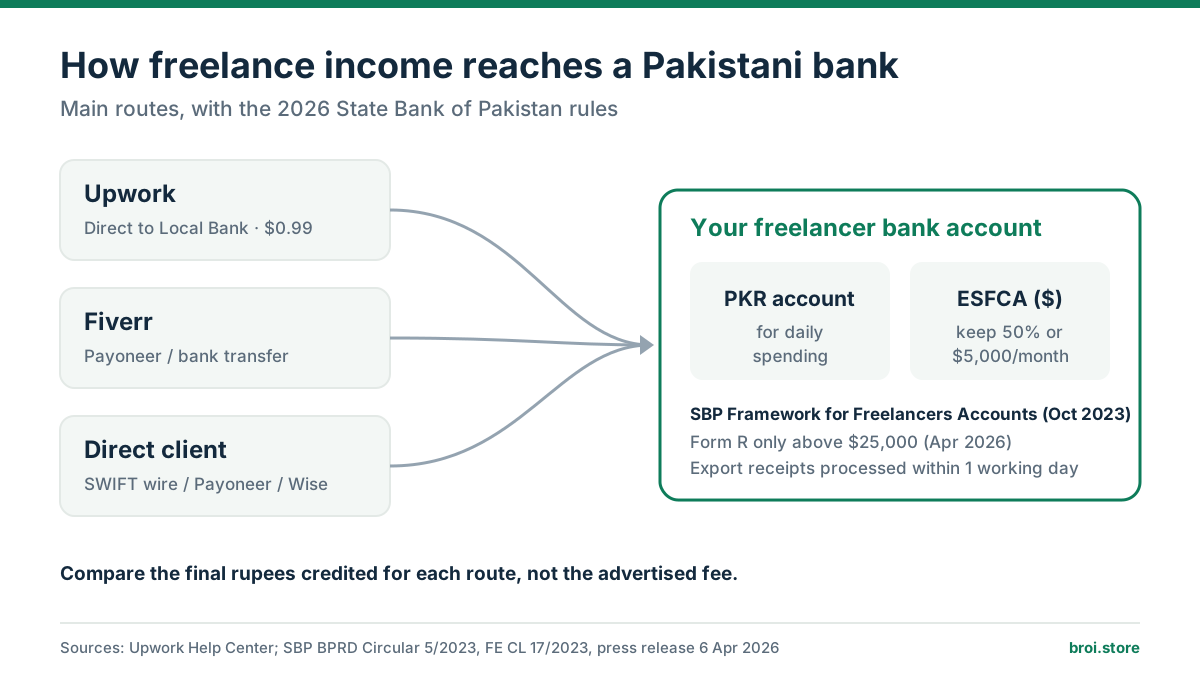
The main options compared
The table compares features rather than claiming any method is always cheapest. Exact costs depend on the platform, your account, the currency and your bank.
| Option | Best for | Main advantage | Main limitation |
|---|---|---|---|
| Upwork Direct to Local Bank | Upwork freelancers | Published fee of $0.99 per withdrawal | Exchange rate and any bank charges still apply |
| Payoneer | Marketplace payouts and direct clients | Built for cross-border business payments | Withdrawal and conversion costs vary by account |
| Direct SWIFT transfer | Direct clients, larger invoices | Goes straight through the banking system | Intermediary fees and exchange-rate margins |
| Wise transfer to a Pakistani bank | Clients who can send via Wise | Sender sees the fee and rate upfront | Not the same as you holding a Wise USD account |
| Freelancer bank account (PKR + ESFCA) | Regular service-export income | PKR banking plus foreign-currency retention | Terms, documents and charges vary by bank |
| Other marketplace payouts | Fiverr and other platforms | Convenient for platform earnings | Availability, fees and terms vary |
Let’s look at each.
Upwork Direct to Local Bank
If you earn on Upwork, check Direct to Local Bank before choosing another payout service.
Upwork charges $0.99 per Direct to Local Bank withdrawal. Its Help Center lists a minimum of $5 and a maximum of $8,999 per withdrawal for Pakistan, and says transfers usually arrive within four business days. Requests made before 12:00 noon UTC are processed the same day. Your bank may charge its own incoming fee.
Why it can be attractive:
- The payout goes straight to your bank, with no extra account in between.
- The platform’s withdrawal fee is clear and small.
- You can easily compare the final rupee amount with other methods.
Before choosing it, check the exchange rate you’ll get and whether your bank charges anything on receipt. Full Upwork costs are in Upwork Fees Explained.
Payoneer
Payoneer is a common international option for freelancer and business payments, including payouts from supported marketplaces.
Its pricing varies a lot by payment route. Receiving marketplace payouts is often free, while payments from other customers, card payments and withdrawals with currency conversion each carry their own charges. Payoneer has also changed its fees for Pakistani users in the past. The key lesson: don’t assume one percentage applies to every Pakistani account.
Payoneer makes sense if your marketplace supports it, your client prefers it, or its withdrawal quote compares well with the alternatives. Before confirming a withdrawal, check the fee and the amount you’ll receive as shown in your own account.
Direct bank transfer through SWIFT
A client can also send payment straight to your Pakistani bank by international wire, usually through SWIFT. Your bank will tell you what details the client needs, typically your account title, IBAN, bank name and the bank’s SWIFT/BIC code.
This option is particularly worth considering when:
- You invoice a company directly rather than earning through a marketplace.
- Your invoices are large enough that fixed transfer costs are relatively small.
- Your bank offers a good exchange rate or a foreign-currency account.
- You want a simple, direct record of the payment.
International wires can involve intermediary deductions. Ask the client which charge option they’ll use, and ask your bank how it processes incoming service-export payments. The sending bank’s fee may not be the whole cost.
Wise: what Pakistani residents need to know
Two different Wise services often get confused.
First, a foreign client may be able to use Wise to send Pakistani rupees to your personal bank account in Pakistan. The client typically needs your full name and IBAN. Wise’s PKR transfer guide lists which Pakistani account types can receive these transfers, and some business and specific account types currently cannot.
Second, that doesn’t mean a Pakistani resident can automatically open a Wise account that receives USD with account details, or use every Wise Business feature. Eligibility varies by country and product.
If a client suggests Wise, confirm who will start the transfer, which currency you’ll receive and how many rupees should reach your account before you agree.
Open a Pakistani freelancer bank account
If you earn freelance income regularly, this option deserves special attention.
In October 2023 the State Bank of Pakistan issued a Framework for Freelancers Accounts (BPRD Circular No. 5 of 2023). It allows freelancers to open a primary PKR account alongside an Exporters’ Special Foreign Currency Account (ESFCA), in person or remotely. Under SBP foreign-exchange rules, IT exporters and freelancers can keep the higher of 50% of export proceeds or USD 5,000 per month in their ESFCA, and use it for permitted payments abroad such as software subscriptions.
In April 2026, SBP simplified things further for IT exporters and freelancers:
- Form R is no longer needed for each export transaction; it’s now required only for receipts above USD 25,000.
- Instead, you make a one-time declaration of the nature of your services when opening an account (or when your bank asks, for existing accounts), and the bank assigns the right purpose code.
- Banks must process inward export receipts and outward remittances from ESFCAs within one working day.
Ask your bank:
- Can I open a freelancer account digitally?
- Can I receive payments for services I export?
- Can I open a linked foreign-currency (ESFCA) retention account?
- What documents do I need to prove my income and its source?
- What exchange rate, inward remittance fees and account fees apply?
- Can I pay eligible business expenses from the foreign-currency account?
Don’t expect every bank to offer identical features. Confirm the latest terms before deciding. Registering with PSEB can also lower your tax rate on IT exports; see How to Register as a Freelancer with PSEB.
Fiverr and other marketplace payouts
If you use Fiverr or another marketplace, start with that platform’s withdrawal options for Pakistan. Note that PayPal doesn’t operate in Pakistan, so most Pakistani Fiverr sellers withdraw through Payoneer or a bank transfer option.
By the time you withdraw, your balance may already be lower than what the client paid, because of the service fee, cancellations, refunds or other adjustments. The withdrawal method can then add its own costs. Before choosing, check:
- the marketplace fee on your earnings,
- the payout provider’s fee,
- any minimum withdrawal amount,
- the exchange rate used to convert to PKR, and
- whether your bank charges an extra fee.
Don’t compare marketplace payouts with direct client transfers without accounting for the marketplace’s own fee. They’re separate parts of the total cost. Fiverr’s fees are explained in Fiverr Fees Explained for Sellers.
Example: receiving $500 in Pakistan
You finish a $500 project and want to estimate what you’ll receive. For illustration we use a reference rate of PKR 277 per dollar. That’s an assumption for the calculation, not a live quote.
$500 × PKR 277 = PKR 138,500
Now imagine three outcomes, with all deductions expressed as a dollar equivalent:
| Scenario | Total deduction | Rupees received |
|---|---|---|
| A | $1 | about PKR 138,223 |
| B | $5 | about PKR 137,115 |
| C | $10 | about PKR 135,730 |
These are illustrations, not the verified costs of any particular service. The gap between scenarios A and C is PKR 2,493, which is worth comparing even on a modest payment. Compare the amount credited rather than picking a method by name. The Payment Method Comparison Calculator lets you test your own figures.
Which method should you choose?
- If you earn on Upwork: compare Direct to Local Bank with Payoneer using the actual withdrawal quotes in your account.
- If you work with foreign clients directly: discuss payment methods with them and compare Payoneer with a direct bank transfer.
- If you receive regular international income: ask your bank about a freelancer account, foreign-currency retention, documentation and conversion costs.
- If a client offers Wise: confirm the exact route and that your account can receive it, rather than assuming you need a Wise account.
Checklist before accepting payment
Before settling on a method, make sure you can answer these:
- Does the provider support my country, account type and payment route?
- Have I separated the marketplace fee from the payment fee?
- Have I checked the exchange rate and the estimated PKR amount?
- Will intermediary or receiving-bank charges apply?
- Have I double-checked the recipient name and bank details?
- Will I keep invoices, payment confirmations and bank statements?
These steps reduce surprises and make it easier to find the most cost-effective method for your situation. Good records also make tax filing much simpler; see Do Freelancers in Pakistan Pay Income Tax?.
Frequently asked questions
What is the cheapest way to receive freelance payments in Pakistan?
There’s no single cheapest method for everyone. For Upwork earnings, Direct to Local Bank has a small, fixed $0.99 fee, but the exchange rate matters too. Compare the final rupee amount across the methods available to you.
Does PayPal work in Pakistan?
No. PayPal doesn’t offer accounts for Pakistani residents, so freelancers use alternatives such as Payoneer, bank transfers or platform-specific withdrawal methods.
Can I keep my freelance income in US dollars?
Through an Exporters’ Special Foreign Currency Account at a Pakistani bank, freelancers can retain the higher of 50% of export proceeds or USD 5,000 per month, subject to SBP rules and your bank’s terms.
Do I still need Form R for every payment?
Not since April 2026. SBP now requires Form R only for export receipts above USD 25,000. For smaller payments, a one-time declaration of the nature of your services is enough.
Final thoughts
Receiving freelance payments in Pakistan isn’t just a matter of finding a provider that accepts international money. It’s about choosing a route that suits your client, keeps costs predictable and leaves a reliable record of your income.
For marketplace work, compare the platform’s payout options. For direct clients, compare Payoneer and bank transfers using real quotes. For regular export income, ask your bank about a freelancer account. Always check the total cost before committing, because a method that suits one freelancer can be expensive or unavailable for another.
Sources
- Upwork Help: Fees, limits and timing of Direct to Local Bank payments
- State Bank of Pakistan: BPRD Circular No. 5 of 2023, Framework for Freelancers Accounts
- State Bank of Pakistan: FE Circular Letter 17 of 2023, Annexure A (ESFCA retention)
- State Bank of Pakistan: Press release, 6 April 2026 (IT export facilitation)
- Ministry of IT & Telecom: SBP facilitation measures for IT exporters and freelancers
- Payoneer: Pricing
Run your own numbers
Compare up to three payment routes by the rupees that actually reach your bank.
Open the Payment Method Comparison Calculator