Payoneer vs. Wise vs. Direct Bank Transfer: Which Loses You the Least Money?
Payoneer, Wise or a SWIFT bank transfer? The fees to compare, a $1,000 example in PKR and a simple formula for your real cost of getting paid in Pakistan.
In this guide
A $1,000 payment looks great in US dollars. The real question is how many Pakistani rupees reach your bank account after transfer fees, currency conversion, intermediary bank charges and withdrawal fees.
Freelancers in Pakistan usually choose between three routes: Payoneer, Wise and a direct bank transfer. They don’t work the same way, and the cheapest option depends on how your client pays, which currencies are involved and the fees on that specific transaction.
The right comparison isn’t “which service advertises the lowest fee”. It’s how many rupees you receive for the same dollars.
The three options at a glance
Payoneer
Payoneer is widely used by freelancers, agencies and online marketplaces. It’s convenient when your marketplace pays out to Payoneer, or when your client can pay into a Payoneer receiving account. Your total cost depends on how the money arrives, the currency conversion and how you withdraw to your local bank.
Wise
Wise is a money transfer service known for showing the exchange rate and fee upfront, before the transfer is confirmed. But which Wise features you can use depends on your country. Pakistani residents should check which Wise products are actually available to them, rather than assuming they can open every type of Wise account or receive payments with Wise account details.
Direct bank transfer
The client sends money straight to your Pakistani bank account, usually by international SWIFT wire. You don’t need another payment account, but the sending bank, any intermediary banks and your receiving bank may each take a fee, and the exchange rate margin can further reduce what you get.
Which fees should you compare?
A single payment can face several separate charges. Looking at only one gives you a misleading picture.
- Receiving fee: charged for accepting a payment into your account.
- Transfer fee: charged for moving money between accounts or institutions.
- Currency conversion: the gap between the rate you get and a market reference rate (often called the spread or margin).
- Withdrawal fee: charged for moving your balance to a local bank.
- Intermediary fee: deducted by banks that help route an international wire.
- Platform fee: charged by the freelance marketplace before the money ever reaches your payment provider.
Some fees are fixed, some are a percentage, and some are taken by institutions you never chose. A low transfer fee doesn’t guarantee a low total cost.
Worked example: receiving $1,000
A freelancer receives $1,000 and wants Pakistani rupees. For a fair comparison we use a reference rate of PKR 277 per US dollar, close to the interbank rate in late October 2026. At that rate, $1,000 is worth PKR 277,000.
Now apply three illustrative total costs. These are not the actual current charges of Payoneer, Wise or any Pakistani bank; they show how the calculation works.
| Route (illustrative total cost) | Calculation | Rupees received |
|---|---|---|
| Option A at 1.0% | 277,000 × 0.990 | PKR 274,230 |
| Option B at 1.5% | 277,000 × 0.985 | PKR 272,845 |
| Option C at 2.0% | 277,000 × 0.980 | PKR 271,460 |
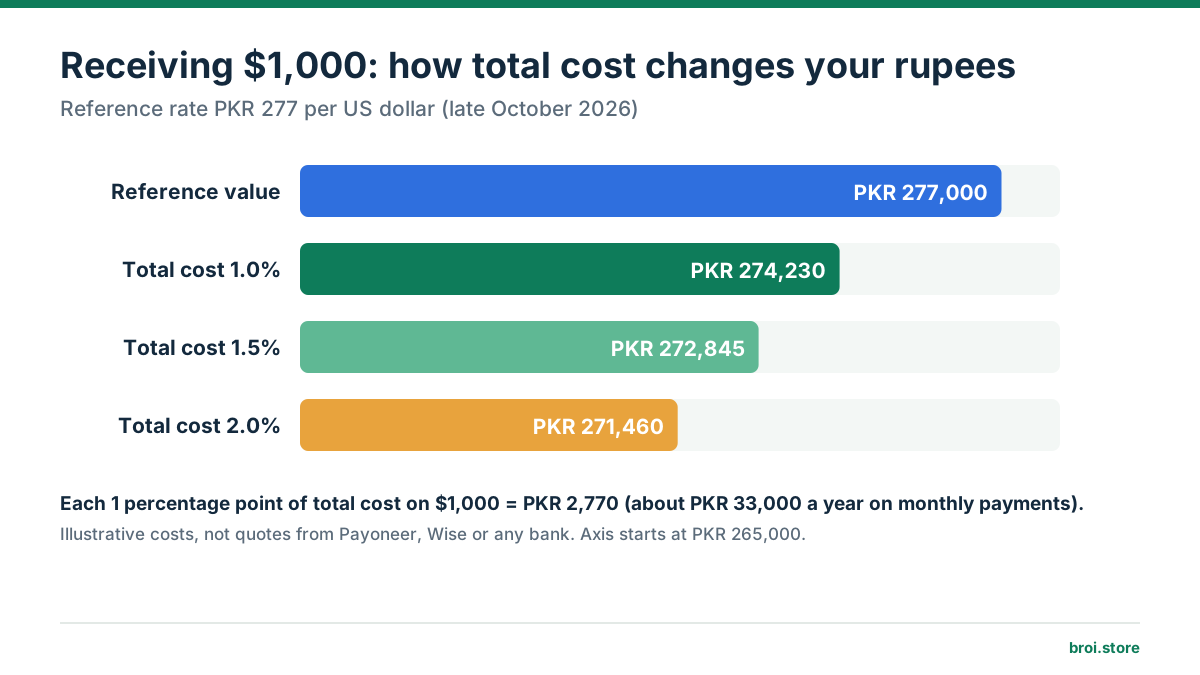
These figures assume the percentage covers all payment and conversion costs. Real transactions can include fixed fees, different exchange rates or deductions before the money reaches you.
The lesson is simple: one percentage point of total cost on $1,000 is PKR 2,770. If you receive $1,000 every month, that’s over PKR 33,000 a year. Small differences matter.
Which option is cheapest in practice?
Payoneer: useful when your payment route already supports it
Payoneer is convenient for marketplace payouts and international client payments where it’s supported. Its value isn’t only the fee: easy receiving, compatibility with freelance platforms and withdrawal to a local bank all count.
Don’t assume every Payoneer account has the same fees, though. Charges depend on how you’re paid, your account, the currency and how you withdraw. Payoneer has changed its fee structure for Pakistani users before; in 2025 it introduced charges on some incoming payments from other customers. Check the “Fees” section of your own Payoneer account before relying on it for large payments.
Wise: transparent pricing, if the route is available to you
Wise is useful when the transfer route is supported, because the fee and exchange rate are usually displayed before the sender confirms. That makes it easy to predict what you’ll receive.
But there’s an important difference between a client being able to send money to Pakistan through Wise and you being able to open and use every Wise product as a Pakistani resident. Don’t ask clients to pay into a Wise USD account until you’ve confirmed you can actually hold and use one.
Direct bank transfer: worth checking for larger invoices
A SWIFT transfer can make sense when a client pays a large invoice straight to your bank. It also keeps a clean, direct record of the payment.
The costs, however, are harder to predict. The sending bank, intermediary banks, your bank and the conversion rate can all affect the final amount. Ask your bank about its inward remittance charges and the exchange rate it will apply, and agree with your client who pays the sending and intermediary charges.
The hidden factor: the exchange rate
Suppose one service converts at PKR 276 per dollar and another at PKR 273. On $1,000, that’s a PKR 3,000 difference before any visible fees are counted.
So a service with a low headline fee but a weaker exchange rate can leave you with less money overall. Always compare the final amount credited, not the individual fees. A fair comparison uses:
- the same payment amount,
- the same currencies,
- the same destination account, and
- quotes taken at about the same time.
We look at this hidden cost in more depth in How Currency Conversion Eats Your Earnings.
How to compare your next payment
Before choosing a route, collect four numbers:
- The amount your client will send.
- Every fee deducted before the money reaches your account.
- The exchange rate used for conversion.
- The final amount credited to your Pakistani bank account.
Then calculate your effective cost:
Effective cost (%) = [(Reference value − Amount received) ÷ Reference value] × 100
Use the same reference exchange rate for every option. If the payment comes through a marketplace, record the marketplace fee separately so you don’t blame it on the payment provider.
The Payment Method Comparison Calculator does this for up to three routes at once: enter each option’s fees and exchange rate and it shows the rupees received and the effective cost side by side.
Which one should you choose?
There’s no universal winner.
- Consider Payoneer if your marketplace or client already supports it and the withdrawal and conversion costs quoted in your account are competitive.
- Consider Wise if the specific service you need is available to you and the total cost shown is lower.
- Consider a direct bank transfer if your bank offers a competitive rate and predictable inward charges, especially for larger payments.
The best method is the one that gives you the most reliable, legal and well-documented route with the strongest final amount. Compare the credited amount, confirm eligibility, and keep invoices and transfer records for tax and banking purposes. Tax rules for freelancers are explained in Do Freelancers in Pakistan Pay Income Tax?.
Frequently asked questions
Is Payoneer or Wise cheaper for Pakistani freelancers?
It depends on the route. Compare the final rupee amount credited for the same payment at the same time, not the advertised fee. Also check that the Wise product you need is available to Pakistani residents.
Can I receive money from Upwork or Fiverr directly in my Pakistani bank?
Upwork offers Direct to Local Bank for Pakistan at $0.99 per withdrawal. Fiverr payouts in Pakistan typically go through Payoneer or a bank transfer option. Check the methods available in your own account. See How to Receive Freelance Payments in Pakistan.
Why did I receive fewer rupees than Google’s exchange rate suggested?
Most providers convert at a rate slightly below the market reference rate and may charge separate fees. The difference is a real cost, even when it doesn’t appear as a line item.
Who pays the fees on a SWIFT transfer?
It depends on the charge option the sender chooses. Agree with your client in advance, and ask your bank what it charges for incoming transfers.
Sources
Run your own numbers
Compare up to three payment routes by the rupees that actually reach your bank.
Open the Payment Method Comparison Calculator