How Currency Conversion Quietly Eats Your Earnings (With a Real Example)
Exchange-rate margins can cost freelancers thousands of rupees a year without showing as a fee. See the maths and how to measure your real cost.
In this guide
- The cost hidden inside the exchange rate
- How to calculate the loss
- What happens over a full year?
- Why the advertised fee doesn’t tell the whole story
- Five places freelancers lose money
- A simple record to measure your real cost
- What Pakistani freelancers should do differently
- The bottom line
- Frequently asked questions
A client pays you $1,000. The invoice is settled, the project is done and the money is on its way. But when your dollars turn into Pakistani rupees, the amount is lower than you expected.
You check the transfer fee. It looks reasonable, and there’s no obvious large deduction. So where did the rest go?
Often the answer is currency conversion. Your payment provider or bank may convert your dollars at a rate less favourable than the reference rate you used to estimate the payment. That gap costs you money even when the visible fee is small.
For Pakistani freelancers, a few rupees per dollar adds up across monthly invoices, annual income and long-term savings.
The cost hidden inside the exchange rate
An exchange rate tells you how much of one currency you get for another. But the rate in your currency converter usually isn’t the rate your provider uses. Three figures are worth separating:
- Reference rate: the benchmark you compare against, such as the mid-market or interbank rate.
- Provider rate: the rate your bank, Payoneer or another provider actually applies to your transaction.
- Amount credited: the money that finally reaches your bank account after all fees.
The gap between the reference rate and the provider’s rate is called the exchange rate margin or spread. Some providers also charge a separate conversion fee.
The key point is that the spread usually doesn’t appear as a “fee” line. You simply receive fewer rupees than your calculation suggested.
How to calculate the loss
Let’s use illustrative rates rather than pretend to know a provider’s live rate. You receive $1,000 from a foreign client, and we use a reference rate of PKR 277 per dollar, close to the interbank rate in late October 2026.
$1,000 × PKR 277 = PKR 277,000
Now compare three hypothetical conversion outcomes:
| Rate applied | Rupees received | Difference from reference |
|---|---|---|
| Reference: PKR 277.00 | PKR 277,000 | n/a |
| Provider A: PKR 275.00 | PKR 275,000 | −PKR 2,000 |
| Provider B: PKR 272.00 | PKR 272,000 | −PKR 5,000 |
With Provider A you receive PKR 2,000 less than the reference value; with Provider B, PKR 5,000 less. These differences come from the assumed rates alone, not from any confirmed fee charged by a real provider. They show how much a “slightly worse” rate matters: every rupee per dollar on a $1,000 invoice is PKR 1,000.
What happens over a full year?
One transaction may not seem worth worrying about. But freelancers are paid regularly, so the cost compounds.
Suppose you receive $1,000 every month, and your conversion rate is consistently PKR 2 below the reference rate.
Monthly: $1,000 × PKR 2 = PKR 2,000
Annual: $1,000 × 12 × PKR 2 = PKR 24,000
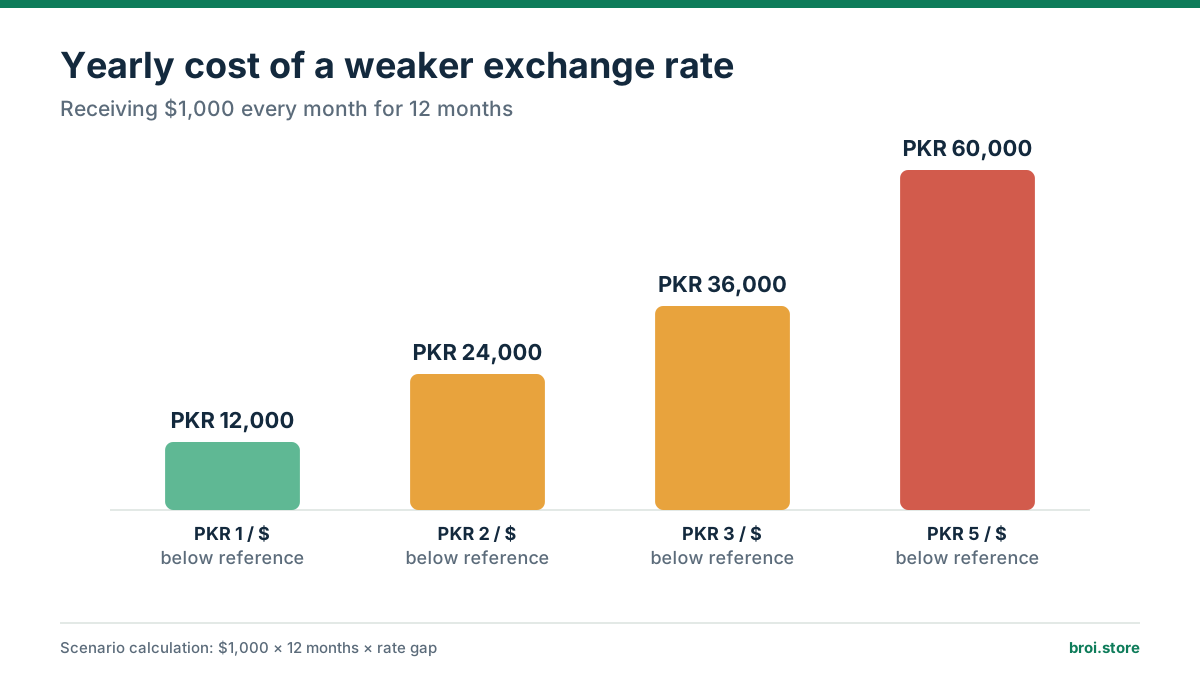
That’s PKR 24,000 a year, and PKR 60,000 if the gap is PKR 5 per dollar. This is a scenario, not a prediction of any provider’s charges, and rates shift between payment dates. But it shows why comparing payment methods isn’t only for people with big corporate invoices. It matters just as much for freelancers who receive modest amounts regularly.
Why the advertised fee doesn’t tell the whole story
Imagine two payment options for $1,000:
- Option A: $5 transfer fee, converts at PKR 276 per dollar.
- Option B: $2 transfer fee, converts at PKR 273 per dollar.
Option A: ($1,000 − $5) × 276 = PKR 274,620
Option B: ($1,000 − $2) × 273 = PKR 272,454
Option A gives you PKR 2,166 more, despite charging a higher visible fee. (This assumes the fee is deducted in dollars before conversion; real providers may calculate it differently.) Comparing only advertised transfer fees would lead you to the wrong choice. Always compare the amount set out for your own transaction.
Five places freelancers lose money
1. Converting at the wrong moment
Some accounts let you hold a foreign-currency balance instead of converting immediately. That gives you flexibility, but holding currency also exposes you to exchange-rate movements and can involve restrictions or account fees. Don’t assume every foreign-currency service is available to Pakistani residents. We cover this decision in Convert Your Dollars or Hold Them?.
2. Blaming the provider for the marketplace’s deduction
A platform may take its service fee before the money reaches Payoneer or your bank. That’s a separate cost from currency conversion. If your invoice is $1,000 but the platform releases $900 after its fee, measure your conversion cost on the $900, or you’ll wrongly blame the whole difference on the payment provider.
3. Comparing rates at different times
Exchange rates move. Comparing your bank’s Monday rate with a provider’s Wednesday rate can mislead you. Get quotes close together, for the same amount and currency pair.
4. Overlooking fixed fees
A $5 fee is 0.5% of a $1,000 payout but 10% of a $50 payout. If you receive many small payments, consider withdrawing larger amounts less often, where the platform’s rules, your cash flow and payment risk allow.
5. Forgetting the receiving bank
An international transfer can pass through a sending bank, an intermediary bank and your receiving bank, and each may charge fees or convert. Ask your bank how it handles incoming freelance payments, especially SWIFT transfers.
A simple record to measure your real cost
You don’t need accounting software to see what conversion is costing you. Record these fields for every payment:
| Field | Example |
|---|---|
| Gross client payment | $1,000 |
| Platform fee | $0 (direct client) |
| Amount sent to payment provider | $1,000 |
| Reference exchange rate | PKR 277 |
| Reference value | PKR 277,000 |
| Amount actually credited | PKR 274,500 |
| Total difference | PKR 2,500 |
| Effective cost | about 0.90% |
Effective cost = [(277,000 − 274,500) ÷ 277,000] × 100 ≈ 0.90%
The PKR 2,500 is the total difference between the reference value and what was credited. It may include transfer or intermediary fees, so don’t automatically label all of it “conversion fees”.
Do this across several payments. One transaction can be skewed by timing or an unusual charge, but a few months of records reveal a consistent pattern. The Payment Method Comparison Calculator calculates the effective cost for you.
What Pakistani freelancers should do differently
Before your next payment, ask your provider or bank three questions:
- What exchange rate will apply to this transaction?
- What separate fees will be deducted before the money arrives?
- Exactly how much will be credited to my Pakistani account?
If your bank offers a freelancer account with foreign-currency retention, ask whether you can keep part of your export earnings in dollars instead of converting everything at once. Under the State Bank of Pakistan’s rules, IT exporters and freelancers can retain the higher of 50% of export proceeds or USD 5,000 per month in an Exporters’ Special Foreign Currency Account (ESFCA), subject to applicable conditions. Check your bank’s current rules and account terms before relying on this. More on freelancer accounts in How to Receive Freelance Payments in Pakistan.
The bottom line
Currency conversion can quietly reduce your income, because the rate applied to your payment may differ from the benchmark you’re using. The effect becomes obvious once you receive regular payments or larger invoices.
The fix isn’t to chase whichever provider claims to be cheapest. It’s to track what actually reaches your account, calculate your effective cost and judge the whole transaction instead of one advertised fee.
Your invoice shows what you earned. Your bank balance shows what you kept.
Frequently asked questions
What is an exchange rate spread?
It’s the difference between the market reference rate and the rate a bank or payment provider actually gives you. It’s a cost even when it isn’t shown as a fee.
How do I find the reference rate to compare against?
Use a published mid-market or interbank rate taken at the same time as your conversion, such as the rate shown by a financial data site or the State Bank of Pakistan’s published rates. The exact source matters less than using the same one consistently.
Is it better to withdraw often or in larger amounts?
If your withdrawal method has a fixed fee, larger, less frequent withdrawals reduce the fee as a percentage. Balance that against your cash-flow needs and exchange-rate risk.
Sources
Run your own numbers
Compare up to three payment routes by the rupees that actually reach your bank.
Open the Payment Method Comparison Calculator