Fiverr Fees Explained for Sellers: What You Actually Keep
Fiverr keeps 20% of every order, including extras and tips. See what you keep on $10 to $1,000 orders and how to price gigs to hit your target.
In this guide
- How much does Fiverr charge sellers?
- Does Fiverr charge on every order?
- Does Fiverr take a fee on tips?
- When can you withdraw your earnings?
- Are there any other Fiverr costs?
- How to calculate your Fiverr earnings
- How much should you charge on Fiverr?
- Fiverr fees vs. your actual profit
- Is Fiverr worth it despite the fees?
- Tips for managing Fiverr fees
- Frequently asked questions
- Final thoughts
When you start on Fiverr, it’s natural to focus on one thing: how much to charge. Maybe $30 for a logo, $50 for an article or $300 for a website. But there’s another question to answer before you set your prices: how much will you actually receive after Fiverr’s fee?
What the buyer pays isn’t what you keep. Fiverr takes a commission on every order, and depending on how you withdraw, you may also lose money to withdrawal fees and currency conversion.
The good news is that the maths is simple once you understand it. This guide explains Fiverr’s seller fees, walks through practical examples and shows how to price your gigs so the fee doesn’t quietly eat your income.
How much does Fiverr charge sellers?
Fiverr credits sellers with 80% of each order, so the platform keeps a 20% commission. If a buyer pays $100 for your service, your Fiverr earnings are $80, before withdrawal or currency conversion costs.
| Order amount | Fiverr’s 20% fee | Your earnings |
|---|---|---|
| $10 | $2 | $8 |
| $25 | $5 | $20 |
| $50 | $10 | $40 |
| $100 | $20 | $80 |
| $250 | $50 | $200 |
| $500 | $100 | $400 |
| $1,000 | $200 | $800 |
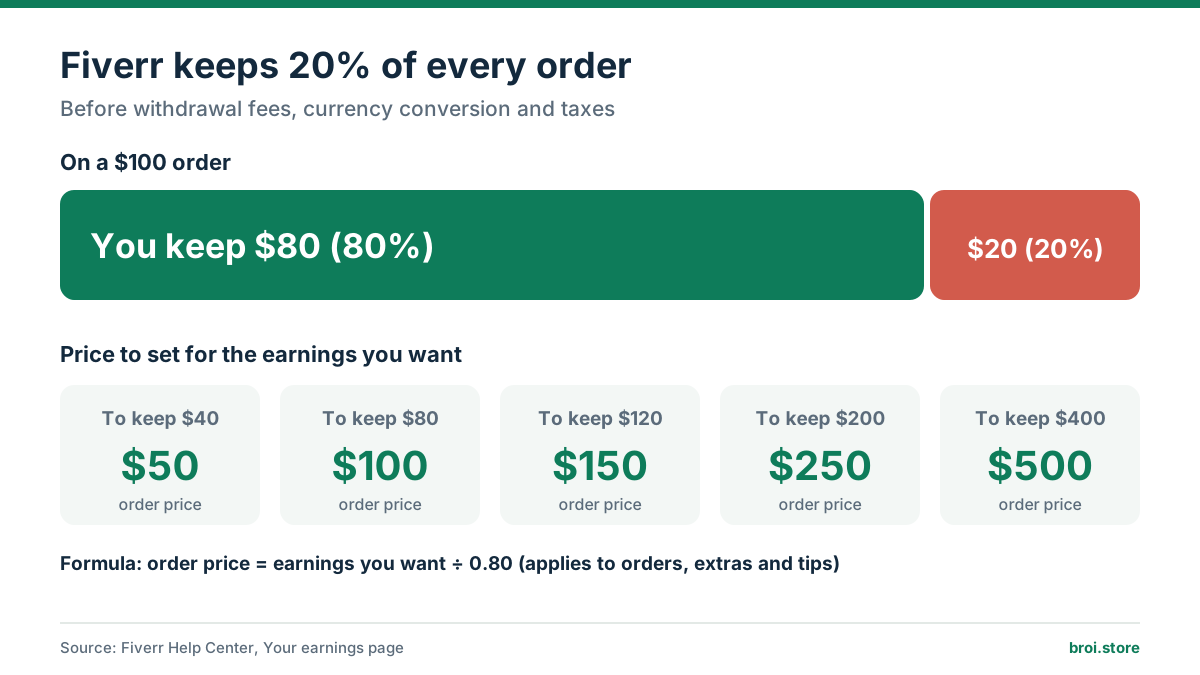
Twenty percent may not sound like much, but it adds up quickly. A seller who generates $1,000 in orders in a month receives $800, before withdrawal costs and other expenses. Understanding this before you set prices is essential.
Does Fiverr charge on every order?
Yes. The 20% commission applies to completed orders, including your gig packages and any extras the buyer adds.
Say you sell a $40 blog post and the buyer adds $10 of keyword research. The order total is $50, so under the standard commission you earn $40. The same goes for packages: whether the buyer picks Basic, Standard or Premium, calculate your earnings from the total order value.
Fiverr has specific rules for cancellations, refunds and other unusual situations. Check the current Fiverr Terms of Service when you need to calculate an unusual order.
Does Fiverr take a fee on tips?
Yes. According to Fiverr’s earnings documentation, the 80/20 split applies to tips as well as orders and extras, so a $20 tip adds $16 to your earnings.
Tips are a welcome bonus when a buyer loves your work, but they’re unpredictable. For budgeting, base your expected income on regular orders, not tips.
When can you withdraw your earnings?
Fiverr holds your earnings as “pending” for a clearance period after an order is completed: 14 days for most sellers, and typically 7 days for Top Rated Sellers and Fiverr Pro sellers. Plan your cash flow around this delay, especially when you’re starting out.
Are there any other Fiverr costs?
The 20% commission is the main fee to understand, but it isn’t the only thing that reduces what reaches your bank.
1. Withdrawal fees
Depending on your country and account, you can withdraw through methods such as Payoneer, bank transfer or PayPal. PayPal doesn’t operate in Pakistan, so Pakistani sellers usually withdraw through Payoneer or a bank transfer option.
Each method can carry its own fixed fee, minimum withdrawal amount and processing time. Fiverr shows the exact fee when you set up or start a withdrawal; at the time of writing, third-party trackers list fixed fees of roughly $1–$3 per withdrawal, depending on the method. If you withdraw $200 and the method costs $2, you’d receive $198 before currency conversion or receiving bank fees.
Because the fee is fixed, small frequent withdrawals cost proportionally more: $2 is 1% of $200 but 10% of $20.
2. Currency conversion
Your Fiverr balance is in US dollars, but if your bank account is in Pakistani rupees, the money must be converted. The rate your payment provider uses can be lower than the rate you see on Google, and some providers add a conversion margin or fee.
For example, if you withdraw $100 and the effective rate is PKR 277 per dollar, you receive PKR 27,700 before any other fees. A rate of PKR 274 would give you PKR 27,400, a PKR 300 difference on just $100. (These are example rates, not live quotes.) We explain this hidden cost in How Currency Conversion Eats Your Earnings.
3. Taxes and business expenses
Fiverr’s commission isn’t income tax. Depending on where you live, you may owe tax on your freelance income. In Pakistan, for example, export income from qualifying services is taxed at 0.25% or 1% (see Do Freelancers in Pakistan Pay Income Tax?). You may also pay for software, internet, stock assets and other tools. These aren’t Fiverr fees, but they still affect what you keep.
How to calculate your Fiverr earnings
The quickest estimate is to subtract the 20% commission:
Net earnings before other costs = Order amount × 0.80
For a $75 order:
- Order amount: $75
- Fiverr commission: $15
- Earnings after commission: $60
If you complete eight $75 orders in a month, your order revenue is $600 and you receive $480 after commission, before withdrawal fees, taxes and business costs.
Keep the two numbers separate: your revenue is the total value of your orders, and your earnings are what Fiverr credits after commission.
How much should you charge on Fiverr?
A common beginner mistake is copying competitors’ prices. A $10 gig might attract buyers, but if it takes three hours, it may not be worth doing at all. Instead, start with the amount you want to receive and work backwards.
To receive a target amount, divide it by 0.80:
Order price = Target earnings ÷ 0.80
| Earnings you want (before other costs) | Order price to set |
|---|---|
| $20 | $25 |
| $40 | $50 |
| $80 | $100 |
| $120 | $150 |
| $200 | $250 |
| $400 | $500 |
These figures don’t include withdrawal costs, taxes or business expenses. If you want to keep a specific amount after everything, include those separately; the Freelance Take-Home Pay Calculator does this automatically in its reverse mode.
Also think about time. Earning $40 from a one-hour job is very different from earning $40 from a six-hour one. A good price covers your time, the complexity of the work, revisions, communication and the value you deliver. Our How to Calculate Your Freelance Hourly Rate guide shows how to work out what your hour is worth.
Fiverr fees vs. your actual profit
Income and profit aren’t the same thing. Say you sell a $300 website package. After the 20% commission you receive $240. If you spend $15 on design assets and $10 on other project costs, $215 remains, before taxes and general business expenses.
That’s a much more realistic view of what you earn. Web developers, designers and video editors who pay for software, plugins, templates or stock assets should price with all their costs in mind, not just the platform commission.
Is Fiverr worth it despite the fees?
For many freelancers, yes, especially when building a portfolio or entering a new market. Fiverr gives you a storefront for your services, handles orders and payments, and helps you build a track record. Those benefits can justify the commission, particularly once you have repeat buyers and can gradually raise prices.
But Fiverr isn’t automatically the best choice for everyone. Consider your type of work, how competitive your niche is, what buyers will pay and how much time each order takes. If you’re working long hours on low-priced orders, more orders won’t fix the problem. Better packages, clear revision limits or more specialised services might. Compare Fiverr with the alternatives in Upwork vs. Fiverr vs. Freelancer.com Fees.
Tips for managing Fiverr fees
- Build the commission into your prices. Calculate your earnings before publishing a gig or accepting a large custom order.
- Track every order. Record the order value, commission, net credit, withdrawal fees and related costs.
- Check withdrawal terms. Review the current fee, minimum, processing time and exchange rate for your chosen method.
- Withdraw in sensible amounts. Fixed withdrawal fees hit small withdrawals hardest.
- Avoid underpricing. Very low prices can win early orders but become unsustainable once revisions and communication pile up.
- Review prices regularly. As your portfolio and reviews grow, revisit your package prices.
Frequently asked questions
Does Fiverr take 20% of every sale?
Yes. Under the standard commission, Fiverr credits sellers with 80% of each order, including extras and tips, and keeps 20%.
How much do I keep from a $100 Fiverr order?
$80, before withdrawal fees, currency conversion, taxes and business expenses.
Does Fiverr charge a monthly seller fee?
No. You can create a seller account and sell without a mandatory monthly subscription. Optional paid plans and promotional tools have their own prices and terms.
Does Fiverr charge withdrawal fees?
Withdrawal methods can carry fees, which depend on the method, your country and your account. Fiverr shows the fee before you confirm a withdrawal.
What price do I need to set to earn $100?
Divide your target by 0.80: $100 ÷ 0.80 = $125. A $125 order leaves you $100 before other costs.
Are Fiverr fees the same in every country?
The standard 20% commission is the same, but the amount you end up with in local currency varies with payment provider fees, exchange rates and other charges.
Final thoughts
Understanding Fiverr’s fees makes it much easier to price your services. The basic rule is simple: you keep 80% of every order.
But don’t stop there. Withdrawal fees, exchange rates, taxes and the cost of doing the work all affect your real profit. Before you set a price, work out what you’ll receive, account for your costs and make sure the order is worth your time. A little planning helps you avoid undercharging and build a more sustainable business.
Sources
Run your own numbers
Platform fee, withdrawal, exchange rate and tax in one place, from the client's dollars to the rupees in your bank.
Open the Freelance Take-Home Pay Calculator