Upwork vs. Fiverr vs. Freelancer.com: Fees Compared Side by Side
Upwork (0–15%), Fiverr (20%) and Freelancer.com (10% or $5) fees side by side, with what you keep on $30, $100 and $1,000 projects.
In this guide
- The fees side by side
- 1. Upwork fees
- 2. Fiverr fees
- 3. Freelancer.com fees
- 4. What do you keep from a $1,000 project?
- 5. Which platform is cheapest for small projects?
- 6. Which platform is best for beginners?
- 7. How to price your services after platform fees
- 8. Don’t forget withdrawal fees and taxes
- 9. Final verdict
- Frequently asked questions
Choosing a freelance platform isn’t only about finding clients. It’s also about how much money you keep once the work is done. You might earn $100 for a website, logo or article, but what lands in your account depends on the platform’s fee and any extra charges.
Upwork, Fiverr and Freelancer.com are three of the most popular platforms, and their fee structures are different enough to make a real difference to your income over time. Some take a straight percentage, one sets a minimum fee that hits small projects hard, and all of them have extra costs for applying to jobs, upgrading your account or withdrawing.
Here’s how their current fees compare, what you actually keep and what matters when choosing.
The fees side by side
| Fee or feature | Upwork | Fiverr | Freelancer.com |
|---|---|---|---|
| Standard freelancer fee | 0% to 15% per contract | 20% of each order | 10% or $5, whichever is greater (fixed-price) |
| Fee on a $100 project | $0 to $15 | $20 | $10 |
| You keep from $100 | $85 to $100 | $80 | $90 |
| Free account | Yes | Yes | Yes |
| Extra costs to consider | Connects, optional Freelancer Plus, withdrawal fees | Optional promotions and plans, withdrawal fees | Limited free bids, optional memberships, withdrawal fees |
| How you find work | Apply to job posts or sell Project Catalog services | Buyers order your listed services (Gigs) | Bid on projects and enter contests |
Upwork’s percentage varies by contract, and Freelancer.com charges a minimum fee on small projects. At first glance Freelancer.com looks cheaper than Fiverr, and Upwork can be cheapest of all when your contract carries a low fee. But the headline percentage doesn’t tell the whole story, because the cost of finding work also affects your profit.
1. Upwork fees
Upwork is built around job posts, proposals, and hourly or fixed-price contracts. You search for work and submit proposals to clients who need your skills.
How much does Upwork charge freelancers?
Upwork currently charges a freelancer service fee of 0% to 15% per contract. The rate is shown before you submit a proposal or accept an offer, and it’s fixed once the contract begins. Check the fee for each opportunity rather than assuming every project has the same rate.
On a $1,000 project:
| Service fee | Amount deducted | You keep |
|---|---|---|
| 0% | $0 | $1,000 |
| 10% | $100 | $900 |
| 15% | $150 | $850 |
The difference between a 0% and a 15% fee on this one project is $150, which adds up quickly across several clients.
Other Upwork costs
A basic account is free, but most job applications need Connects. Additional Connects cost $0.15 each, and the free Basic plan includes 10 a month. Freelancer Plus costs $19.99 a month and includes 100 Connects plus extra tools. Beginners don’t need it.
If you buy 100 extra Connects, you’ve spent $15 before winning anything. Sending many proposals without getting hired reduces your effective income, so focus on relevant jobs and write tailored proposals. More detail is in Upwork Fees Explained.
Who should choose Upwork?
Upwork suits freelancers who want larger projects, long-term client relationships or recurring contracts. Developers, designers, virtual assistants, marketers and writers all find work there, and it’s especially useful when clients need ongoing support rather than a one-off task. Competition can be strong, though, and your portfolio and communication matter as much as the fee.
2. Fiverr fees
Fiverr works differently. Instead of applying for jobs, you create service listings called Gigs. Buyers browse them and order the ones that fit their needs. A writer might sell blog-post packages; a developer might offer WordPress speed optimisation.
How much does Fiverr charge?
Fiverr credits sellers with 80% of each order and keeps 20% as commission. This applies to the full order, including extras and tips.
| Order amount | Fiverr’s 20% | You keep |
|---|---|---|
| $25 | $5 | $20 |
| $50 | $10 | $40 |
| $100 | $20 | $80 |
| $500 | $100 | $400 |
| $1,000 | $200 | $800 |
Does Fiverr charge a monthly fee?
No. A seller account is free. Optional subscriptions and advertising tools cost extra if you choose them. The 20% commission is the cost that matters most: on four $500 orders, you pay $400 in commission.
That doesn’t make Fiverr a bad choice. A platform that brings you steady buyers can be worth the fee. The real question is whether your order volume and prices make it profitable. See Fiverr Fees Explained for Sellers for a full breakdown.
Who should choose Fiverr?
Fiverr suits freelancers who can package their skills into clearly defined services: logo design, WordPress installation, short video edits, SEO audits, content writing or social media graphics. It also appeals to beginners who’d rather build a service listing than write individual proposals. The challenge is standing out among competing sellers, and your prices need to account for revisions and communication time.
3. Freelancer.com fees
Freelancer.com is a bidding marketplace: clients post projects and freelancers submit bids. It also runs contests, where clients receive creative submissions and choose a winner.
How much does Freelancer.com deduct?
According to its official fees page:
- Fixed-price projects: 10% or $5, whichever is greater
- Hourly projects: 10% of each payment
- Contests: 10% or $5, whichever is greater, charged when the prize is released
| Project value | Platform fee | You keep |
|---|---|---|
| $20 | $5 | $15 |
| $50 | $5 | $45 |
| $100 | $10 | $90 |
| $500 | $50 | $450 |
| $1,000 | $100 | $900 |
The $20 project shows why the minimum matters. 10% of $20 is only $2, but the $5 minimum applies, so you lose 25% and keep $15. On anything above $50, the standard 10% applies.
Other Freelancer.com costs
Registration is free. Free members start with 6 bids a month, and Freelancer.com states that you need a minimum account balance before bidding. Paid memberships offer more bids and features. Withdrawals cost $1 for express withdrawal, PayPal, Skrill or the Payoneer debit card, and $25 for an international wire, with a $50 minimum withdrawal.
The low headline fee is attractive, but it doesn’t make the platform cheapest overall if you spend money on upgrades or struggle to win bids.
Who should choose Freelancer.com?
It can suit freelancers who are comfortable with competitive bidding and comparing many projects across categories, from web development and design to writing, data entry and marketing. Evaluate projects carefully before bidding: a very low-budget job may not be worth the platform fee, the time to write a bid and the work itself.
4. What do you keep from a $1,000 project?
Percentages make more sense with a real project value. Here’s a $1,000 project on each platform. To keep the comparison fair, this excludes subscriptions, Connects, withdrawal costs and taxes.
| Platform | Project value | Fee | You keep |
|---|---|---|---|
| Upwork at 10% | $1,000 | $100 | $900 |
| Upwork at 15% | $1,000 | $150 | $850 |
| Fiverr | $1,000 | $200 | $800 |
| Freelancer.com | $1,000 | $100 | $900 |
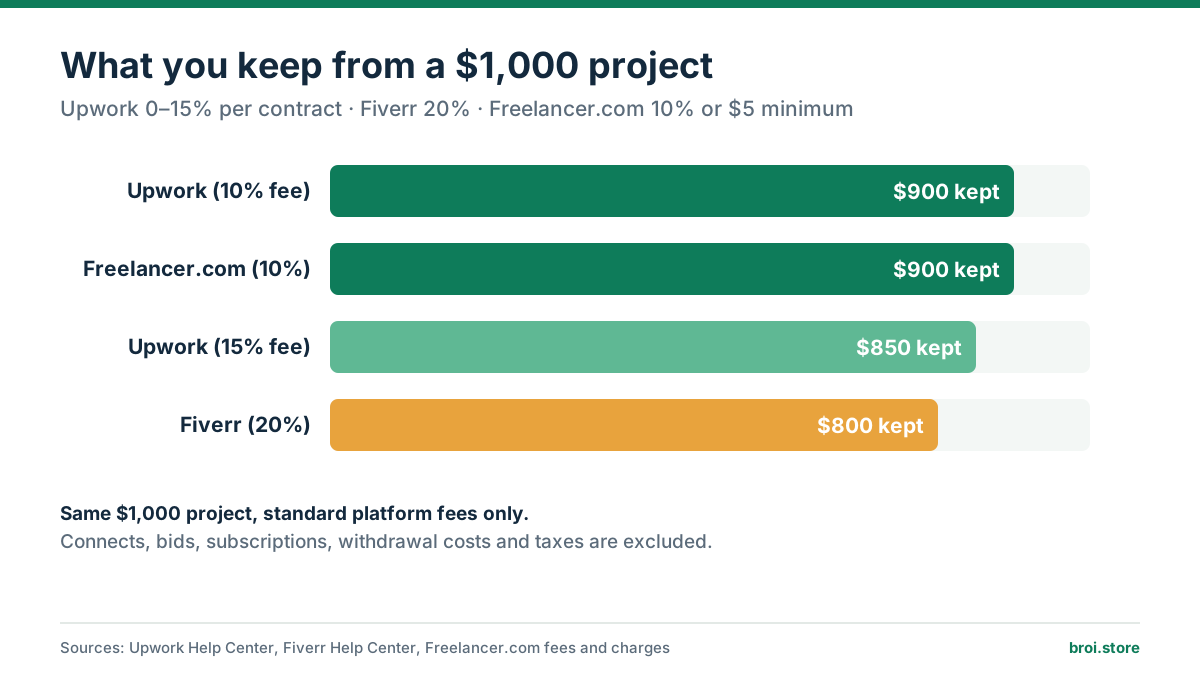
At a 10% fee, Upwork and Freelancer.com both leave you $900. At 15%, Upwork leaves $850. Fiverr leaves $800, which is $100 less than the 10% options on the same project.
Don’t choose a platform on this calculation alone, though. If Fiverr brings you clients consistently while you struggle to win contracts elsewhere, the higher commission can still make financial sense.
5. Which platform is cheapest for small projects?
Small projects give very different results because of Freelancer.com’s $5 minimum. Take a $30 job:
| Platform | Fee | You keep |
|---|---|---|
| Upwork at 10% | $3.00 | $27.00 |
| Upwork at 15% | $4.50 | $25.50 |
| Freelancer.com ($5 minimum) | $5.00 | $25.00 |
| Fiverr (20%) | $6.00 | $24.00 |
Upwork at 10% is cheapest here. Freelancer.com still beats Fiverr, but it leaves you slightly less than Upwork at 15%. On a $10 project, Freelancer.com’s $5 minimum takes half the value, so very cheap services are hard to make profitable there.
The lesson: calculate the actual fee at your expected project price before deciding where to sell. The Freelance Take-Home Pay Calculator lets you switch between platforms and compare instantly.
6. Which platform is best for beginners?
That depends on what you sell, how you prefer to find clients and how much time or money you can invest before your first payment.
Upwork: for building client relationships
Upwork works well if you want a professional freelance career built on proposals and repeat business. It’s particularly good for software development, technical support, marketing and writing. The challenge is finding suitable jobs and spending Connects wisely. A strong profile and relevant samples help you avoid wasting both.
Fiverr: for selling packaged services
Fiverr is practical if you can turn your skills into clear offers with a set price, delivery time and list of deliverables, such as a WordPress audit, a blog post or a set of social media graphics. Once you know which services sell, you can refine your packages and raise prices. Always build the 20% commission into your pricing.
Freelancer.com: for competitive bidding
If you prefer scanning project lists and sending bids, Freelancer.com is another option. The 10% fee is attractive on larger projects, but the $5 minimum makes small jobs less appealing, and you’ll need to manage your bid allowance.
Rather than opening accounts everywhere and applying at random, start with the platform that best fits your service and how you like to find clients.
7. How to price your services after platform fees
A common mistake is setting a price based only on what the client will pay. If you want $100 after the platform’s commission, the price you need depends on the fee:
| Platform fee | Price to earn $100 before other expenses |
|---|---|
| 10% | $111.11 |
| 15% | $117.65 |
| 20% | $125.00 |
The formula is your target divided by the share you keep. On Fiverr you keep 80%, so $100 ÷ 0.80 = $125. Remember that on Freelancer.com projects under $50, the $5 minimum makes the effective commission higher than 10%.
Your price should also cover time spent on communication, revisions, file preparation and admin. A $100 project isn’t a good deal if it takes many hours. If you haven’t worked out your hourly rate yet, see How to Calculate Your Freelance Hourly Rate.
8. Don’t forget withdrawal fees and taxes
The platform commission is only one part of the calculation. Depending on your payment method and country, you may also lose money to withdrawal charges, currency conversion and taxes. These vary so much that a single “typical” withdrawal cost would be misleading.
A freelancer paid in dollars may lose value when converting to rupees, and the payment provider may charge to move money to a bank. Before choosing a platform, check which payout methods are available in your country and what they cost, and remember the difference between your platform balance and what actually reaches your bank. For Pakistan specifically, see How to Receive Freelance Payments in Pakistan.
Your real calculation looks like this:
Net income = Project income − platform commission − business costs − withdrawal fees − currency conversion costs − taxes
9. Final verdict
There’s no single best platform for everyone. The right choice depends on how you find clients, the size of your projects and the fees that apply to your account.
- Upwork is strong for professional projects and long-term clients. Its 0–15% fee means you should check the exact rate before accepting each contract.
- Fiverr works well if you want to sell packaged services and let buyers come to you. Its 20% commission is the highest of the three, so pricing matters.
- Freelancer.com has a competitive 10% fee, but the $5 minimum makes small projects relatively expensive, and you need to manage bids.
The platform that leaves you the most money isn’t necessarily the one with the lowest commission. It’s the one that helps you win valuable projects, do good work and build reliable income without spending more than you can afford.
Frequently asked questions
Which freelance platform has the lowest fees in 2026?
Upwork can be the cheapest when a contract has a low or 0% service fee; its standard range is 0–15%. Freelancer.com usually charges 10% or $5, whichever is greater. Fiverr keeps 20% of each completed order.
Does Fiverr really take 20%?
Yes. Fiverr credits sellers with 80% of each completed order, including extras and tips, and keeps 20%.
Is Freelancer.com cheaper than Fiverr?
For projects above $25, yes: 10% (or the $5 minimum) is less than Fiverr’s 20%. On very small projects, the $5 minimum makes Freelancer.com’s effective rate much higher than 10%.
Do I have to pay to join Upwork, Fiverr or Freelancer.com?
All three offer free registration. Upwork requires Connects for most proposals, Freelancer.com limits free bids, and all three offer optional paid features.
Which platform is best for a full-time income?
There’s no guaranteed winner. Upwork suits professionals seeking ongoing contracts, Fiverr suits those with repeatable packaged services, and Freelancer.com suits people comfortable with bidding. Your skills, portfolio, pricing and reliability matter more than the platform name.
Can I use all three platforms at once?
Generally yes, within each platform’s terms. But managing three profiles takes time, so many freelancers focus on one main platform while testing another.
What should I check before accepting a project?
Confirm the platform fee, project scope, deadlines, revision terms and any costs of finding the job or receiving the money. Then calculate what you’ll keep and whether it pays fairly for your time.
Sources
Run your own numbers
Platform fee, withdrawal, exchange rate and tax in one place, from the client's dollars to the rupees in your bank.
Open the Freelance Take-Home Pay Calculator