How to Budget When Your Freelance Income Changes Every Month
A budgeting system for irregular freelance income, with a six-month example of how paying yourself a fixed salary smooths out good and bad months.
In this guide
Freelancing gives you flexibility and the chance to work with clients around the world. But it also brings a financial challenge most salaried people never face: your income is rarely the same two months in a row.
One month you might land several projects and earn well. The next, clients go quiet, payments are delayed or there’s no new work at all. Unlike an employee, you can’t count on a fixed salary arriving on the same date every month.
That’s why budgeting matters so much for freelancers. A good budget helps you control spending, prepare for slow months and avoid overspending when things are going well.
Why budgeting is different for freelancers
A salaried employee can plan around a predictable income. A freelancer’s earnings depend on:
- How many projects you complete in the month
- When clients pay, and whether payments are delayed
- Seasonal demand for your services
- Changes in workload and available projects
- Exchange rates and international payment costs
A Pakistani freelancer might earn Rs. 150,000 one month and Rs. 75,000 the next. If your spending stays the same, the lower month quickly becomes stressful. The solution is to build your budget around a realistic income, not your best month.
Start with your lowest reliable monthly income
A common approach is to average your income over the last six to twelve months. But averages can mislead you: a couple of unusually good months make your income look more stable than it really is.
Instead, look at the lowest income you can reasonably expect in a normal working month. Here’s an example of six months of freelance earnings:
| Month | Income |
|---|---|
| January | Rs. 120,000 |
| February | Rs. 85,000 |
| March | Rs. 160,000 |
| April | Rs. 95,000 |
| May | Rs. 140,000 |
| June | Rs. 70,000 |
| Average | Rs. 111,667 |
| Lowest | Rs. 70,000 |
The average is about Rs. 111,700, but in half of these months income fell well below that. If you set your lifestyle at the average, you’d come up short three months out of six. A safer baseline is something close to your lower months, for example the average of your three lowest months: (70,000 + 85,000 + 95,000) ÷ 3 = Rs. 83,333.
Build your essential spending around a number like that. A conservative budget protects you when projects slow down.
Give every payment a job
When a client pays you, don’t treat the whole amount as spending money. Split it across your responsibilities:
- Essential expenses: rent, food, electricity, internet, transport and other household costs.
- Business costs: software subscriptions, hosting, equipment, platform fees and anything else you need to keep working.
- Tax savings: set money aside for tax as you earn, rather than scrambling when it’s due. See Do Freelancers in Pakistan Pay Income Tax?.
- Emergency savings: keep part of each payment for unexpected costs and months without work.
- Personal savings and investments: once essentials and obligations are covered, put money towards long-term goals.
The exact percentages depend on your income, family responsibilities and cost of living.
Pay yourself a fixed salary
One of the most effective strategies is to treat yourself like an employee of your own freelance business.
Keep all freelance earnings in a separate business account. Then, once a month, transfer a fixed amount to your personal account. That’s your salary. In good months the surplus stays in the business account. In slow months, that surplus tops up your salary.
Using the six-month example above, suppose you pay yourself Rs. 85,000 every month:
| Month | Income | Salary paid | Buffer change | Buffer balance |
|---|---|---|---|---|
| January | Rs. 120,000 | Rs. 85,000 | +35,000 | Rs. 35,000 |
| February | Rs. 85,000 | Rs. 85,000 | 0 | Rs. 35,000 |
| March | Rs. 160,000 | Rs. 85,000 | +75,000 | Rs. 110,000 |
| April | Rs. 95,000 | Rs. 85,000 | +10,000 | Rs. 120,000 |
| May | Rs. 140,000 | Rs. 85,000 | +55,000 | Rs. 175,000 |
| June | Rs. 70,000 | Rs. 85,000 | −15,000 | Rs. 160,000 |
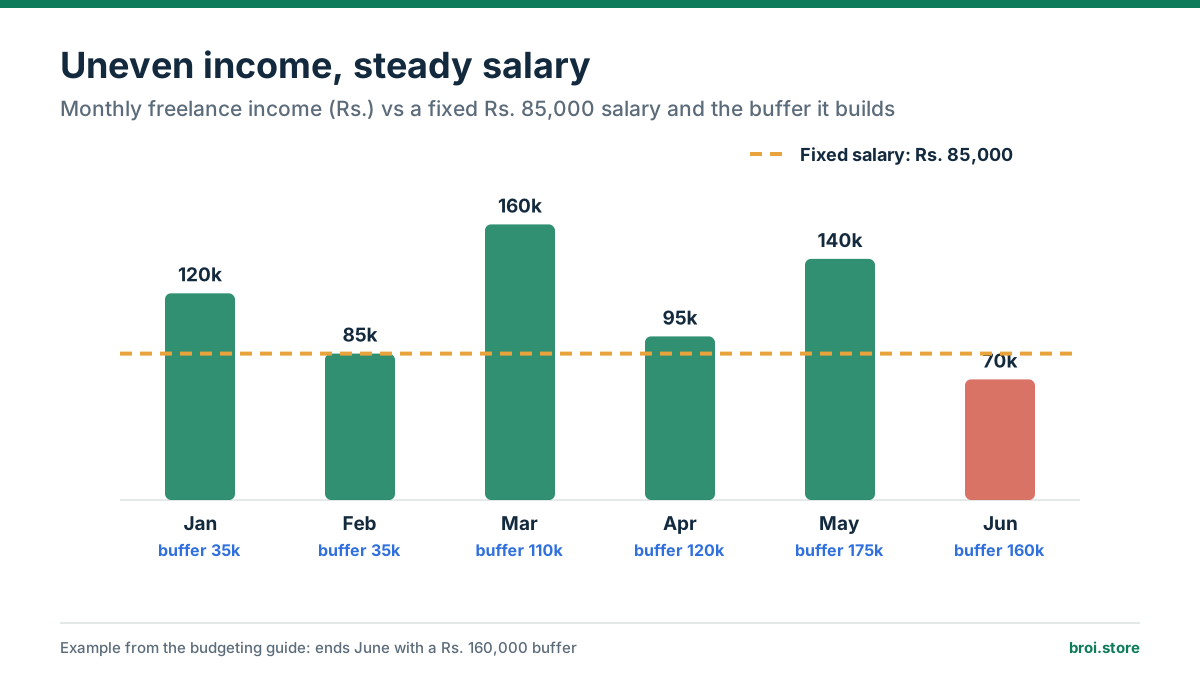
Even though income swung between Rs. 70,000 and Rs. 160,000, your personal income stayed exactly the same every month, and you built a Rs. 160,000 buffer for future slow months, tax and business costs. June’s shortfall was covered without stress.
The Freelancer Budget & Emergency Fund Calculator works out a safe salary from your own income history.
What to do in high-income months
A great month is a chance to strengthen your finances, not a reason to increase your spending. When you earn more than expected, use the extra to:
- Build your emergency fund
- Save for upcoming tax payments
- Pay off debts
- Buy equipment that makes you more productive
- Invest in training and professional development
- Keep a reserve for months with fewer projects
Be careful about raising your regular expenses after one large payment. New subscriptions, expensive purchases or bigger monthly commitments are hard to keep up when income drops.
Plan for late payments
Sometimes you finish a project on time but the client pays days or weeks later, and your bills still have fixed due dates. To reduce that risk:
- Keep a cash buffer that covers at least your next month’s essential costs.
- Agree clear payment terms before starting work.
- Use milestone payments on larger projects so you’re not waiting until the very end.
- If you work on Upwork or Fiverr, understand their payment clearance periods and withdrawal times so you know when money will actually arrive. Fiverr, for instance, holds earnings for 14 days for most sellers.
Make budgeting a monthly habit
A freelance budget isn’t something you set once and forget. At the end of every month, review:
- How much you earned
- How much you spent
- How much you saved
Compare your actual spending with your plan and adjust. A simple spreadsheet or budgeting app is enough. What matters is keeping accurate records. Freelancers don’t need a complicated financial system; they need a consistent one.
Frequently asked questions
How much should a freelancer pay themselves each month?
Base your salary on your lower-earning months rather than your average. The average of your three lowest months over the past six to twelve months is a sensible starting point. Review it as your income becomes more stable.
Should freelancers have separate bank accounts?
Yes, it helps a lot. A separate business account for all freelance income, with a fixed monthly transfer to your personal account, makes budgeting, tax records and saving much easier.
What percentage of freelance income should I save?
There’s no fixed rule, but many freelancers aim to save 10–20% of each payment until they have an emergency fund of several months’ essential expenses. See How Much Emergency Savings Does a Freelancer Need? for how much you need.
Final thoughts
Managing an irregular income takes more planning than managing a fixed salary. But with a conservative budget, controlled spending and saving in your good months, freelancers can create real financial stability.
The most important principle: don’t build your lifestyle around your best month. Build it around a realistic income, and use the extra in good months to prepare for the future. With a disciplined routine, a changing monthly income doesn’t have to mean changing financial security.
Sources
Run your own numbers
Find a safe salary from uneven income and how long your emergency fund will take.
Open the Freelancer Budget & Emergency Fund Calculator