Hourly vs. Fixed-Price Projects: Which Earns More for Beginners?
Hourly or fixed price? Compare both pricing models with real numbers, see how project length changes your effective hourly rate, and learn which suits beginners.
In this guide
- What is hourly pricing?
- What is fixed pricing?
- What does the data say?
- Hourly vs. fixed price at a glance
- Example: which model earns more?
- Which pricing model is better for beginners?
- How to calculate a profitable fixed price
- Protect your time with clear project boundaries
- What about payment security?
- Common pricing mistakes beginners make
- A simple strategy for your first projects
- Frequently asked questions
- Final thoughts
One of the first decisions you make as a freelancer is how to charge. Do you bill by the hour, or agree on a fixed price for the whole project?
Hourly pricing can feel safer at first: you know exactly what each hour earns. Fixed prices can feel harder because you have to commit to a total before you know how long the work will take. But there’s another side to it. On a fixed-price project you can earn more per hour, as you get faster and more confident.
So which makes more sense when you’re just starting? It depends on how well you can estimate time, how clearly you communicate with clients and what kind of work you do. Let’s compare both models with real numbers.
What is hourly pricing?
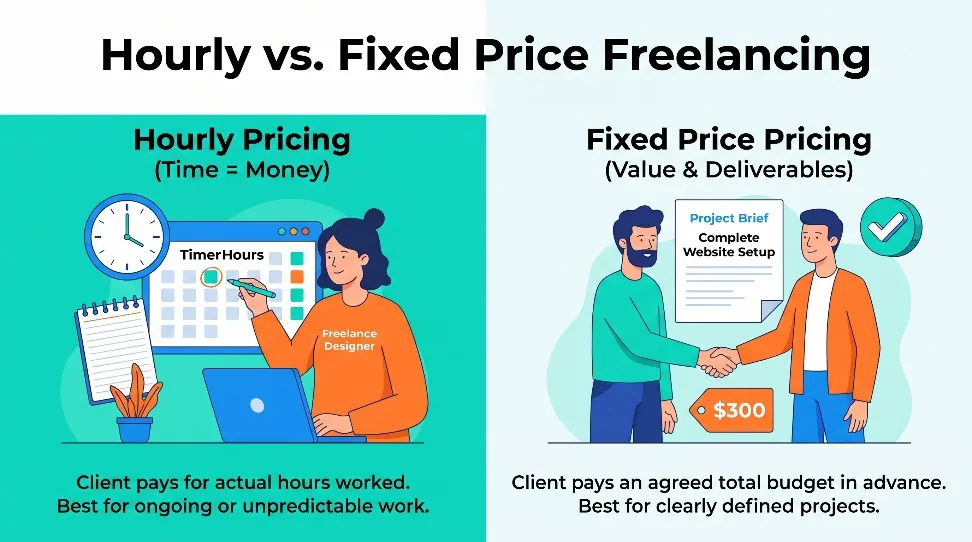
With hourly pricing, you charge the client for the time you spend on their project. If you charge $15 an hour and the project takes 20 hours:
$15 × 20 hours = $300
If the client asks for extra work, you can usually bill the additional time, within whatever limits your contract sets. That makes hourly pricing useful when the work is hard to estimate in advance or the client expects changes. It suits website maintenance, virtual assistance, technical support, content updates and ongoing improvements to an existing product.
Why beginners often prefer hourly pricing
When you’re new, you often don’t know how long a task will take. A website that looks simple may need extra testing, debugging or back-and-forth with the client. Hourly contracts pay you for that time, within the agreed scope. They also teach you how long different tasks really take, which makes your future estimates better.
The limitation is that your income is tied to your hours. If you finish a task faster, you earn less for it, unless you raise your rate or find more work.
What is fixed pricing?
With fixed pricing, you agree on a total price before you start. For example, you might agree to build a business landing page for $300. The client pays for the agreed deliverables, not for each hour.
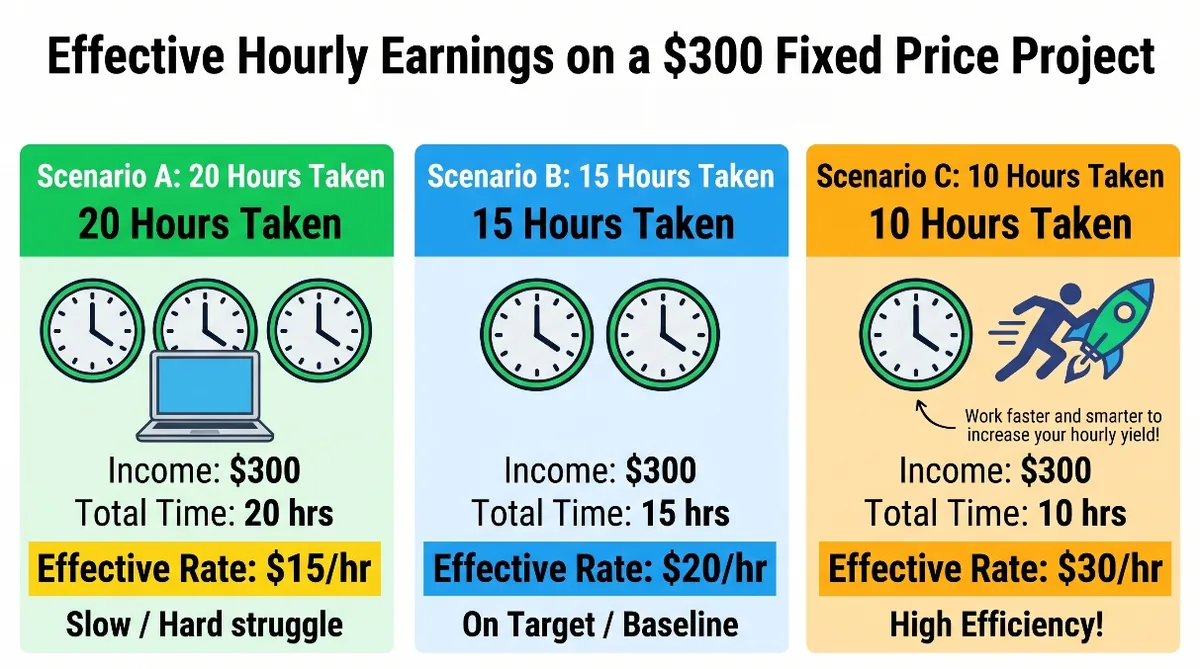
If the project takes 20 hours, your effective hourly rate is:
$300 ÷ 20 hours = $15 per hour
But if, with more experience, you can complete the same project in 12 hours:
$300 ÷ 12 hours = $25 per hour
You still receive $300, but your effective hourly rate rises because you did the work in less time. That’s the biggest advantage of fixed pricing: you benefit from becoming more efficient, as long as you deliver the agreed quality and the project doesn’t grow beyond its original scope.
Why fixed pricing can be attractive
Fixed pricing lets you sell a clearly defined result instead of selling your hours. It’s also easier for many clients to approve. A business owner may happily sign off on a $300 website package but hesitate over an open-ended project with an uncertain final bill.
The risk is that fixed pricing needs careful planning. If you underestimate the work, agree to unlimited revisions or don’t clarify what the client expects, your effective hourly rate can fall fast. Beginners should start with projects that have clear deliverables and manageable requirements.
What does the data say?
Pricing model is only part of the story. A March 2026 iHire survey of 2,250 US workers across 57 industries asked freelancers about their biggest client frustrations. The top two were unclear project scope and expectations (36.1%) and poor or lacking communication (35.6%).
Those figures don’t say which pricing model earns more, but they point to a problem that hurts both. When expectations aren’t clear, freelancers lose time, disagree with clients and struggle to protect their earnings. The practical lesson: how you price matters, but defining the work clearly matters just as much.
Hourly vs. fixed price at a glance
| Factor | Hourly pricing | Fixed pricing |
|---|---|---|
| How you get paid | For hours worked | For agreed deliverables |
| Calculating income | Easy, from tracked time | Set by the agreed fee |
| Risk if work takes longer | Lower, if extra hours are agreed | Higher, because you absorb the extra time |
| Benefit of working faster | May reduce what you earn | Raises your effective hourly rate |
| Scope changes | Easier with an agreed rate and budget | Need a clear change agreement |
| Best for | Ongoing or changing work | Clearly defined projects |
| For beginners | Easier for learning how long tasks take | Good for small, well-defined projects |
Neither model guarantees higher earnings. Your results depend on your price, your time, your costs and how well you manage the agreement.
Example: which model earns more?
A small business needs a landing page. You estimate the work at 15 hours. For this comparison, assume you’d charge $20 per hour or a fixed fee of $300. These are numbers for the calculation, not published market averages.
Scenario 1: You charge by the hour
At 15 hours you earn 15 × $20 = $300.
If extra debugging and agreed changes push the project to 20 hours, you earn 20 × $20 = $400. The extra $100 is paid because the additional time was billable under the agreement and approved by the client.
Scenario 2: You charge a fixed price
You agree to $300. Your effective hourly rate depends entirely on how long the work takes:
| Hours taken | Calculation | Effective hourly rate |
|---|---|---|
| 10 hours | $300 ÷ 10 | $30.00 |
| 15 hours | $300 ÷ 15 | $20.00 |
| 20 hours | $300 ÷ 20 | $15.00 |
| 30 hours | $300 ÷ 30 | $10.00 |
Finish in 10 hours and you’ve earned $30 an hour, 50% more than your $20 hourly rate, without raising the price. That’s why fixed-price work becomes more attractive as your experience grows.
But if the project drags on to 30 hours, you’re down to $10 an hour, half your original estimate. The problem usually isn’t fixed pricing itself. It’s a poor estimate, unclear requirements, too many revisions or extra work that was never part of the agreement.
Before accepting a fixed-price project, calculate what you’ll earn if it takes longer than planned. This simple habit stops you accepting projects that look profitable but aren’t worth your time.
Which pricing model is better for beginners?
If you’re completely new, hourly pricing is a sensible starting point for work that’s hard to estimate. Tracking your time teaches you your real working speed, which is exactly the information you need before quoting fixed prices.
You don’t have to avoid fixed-price projects until you have years of experience. Small, well-defined projects are a good place to start, such as five social media graphics, a 1,000-word article, a simple landing page or a basic WordPress site. What matters is knowing precisely what you’re promising to deliver.
Choose hourly pricing when:
- The work is ongoing maintenance, technical support, research or anything whose requirements may change.
- The client is likely to add tasks as the project develops.
- You’re still learning how long the work takes and don’t want to commit to a total too early.
Choose fixed pricing when:
- You can describe the final deliverable clearly.
- You’ve done similar work before or can estimate it with reasonable confidence.
- The number of revisions and the client’s responsibilities are agreed in advance.
- You can work efficiently without cutting corners.
Many beginners combine both: hourly for uncertain work, fixed prices for repeatable services with a clear scope.
How to calculate a profitable fixed price
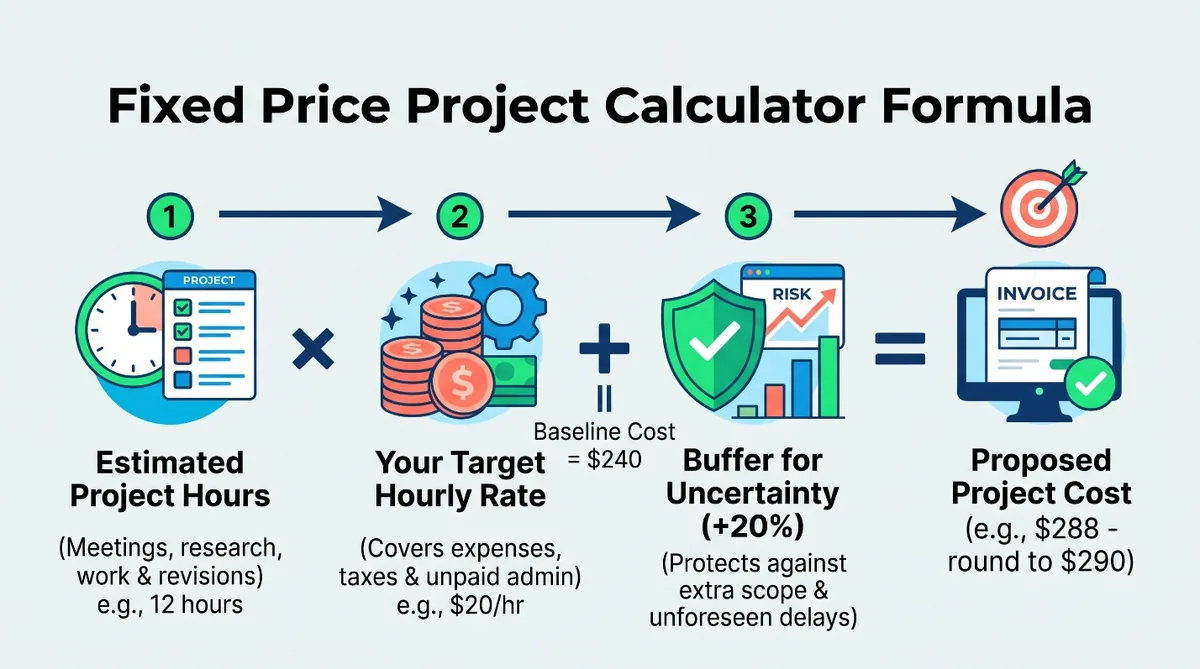
Before quoting a fixed price, estimate the total time the project will take, not just the time spent on the final deliverable. Include client calls, research, revisions, testing and delivery.
Say your target hourly rate is $20 and you estimate 12 hours:
12 hours × $20 = $240 (base price)
Add a 20% contingency for uncertainty:
$240 × 1.20 = $288
You might quote about $290, if that fits the client’s budget and the work involved. The 20% isn’t a fixed rule; use a bigger buffer for unpredictable work and a smaller one for jobs you’ve done many times.
Make sure your target hourly rate already covers business costs, platform fees, taxes and unpaid hours. Otherwise a project can look profitable and still leave you earning less than you think. If you haven’t worked out that rate yet, start with How to Calculate Your Freelance Hourly Rate.
Protect your time with clear project boundaries
The biggest risk in fixed-price work is scope creep, where a project gradually grows beyond the original agreement without any increase in payment.
Imagine you agree to build a five-section landing page. Once you start, the client asks for extra pages, a new contact form, more animations and several rounds of redesign. Each request seems small, but together they can add hours of unpaid work.
To prevent this, write down exactly what the client gets before you start. For a website, that might include the number of pages, features, revision rounds, delivery date and what counts as extra work. When a request falls outside the agreed scope, explain how it affects the price or timeline before doing the extra work. Clear expectations help on hourly contracts too.
What about payment security?
Your pricing model is only part of a good contract; you also need to know how and when you’ll be paid.
Upwork, for example, supports both hourly and fixed-price contracts. Fixed-price projects can be split into milestones, with the client funding each milestone before work on it begins. Hourly contracts use Upwork’s time tracker and weekly billing, and payment protection applies only if you meet its requirements. Read the current rules carefully, because not every type of time entry qualifies.
If you work directly with clients, use a written agreement covering deliverables, payment schedule, deadlines, revisions and what happens when the project changes. For larger fixed-price projects, milestones make payment easier to manage.
Common pricing mistakes beginners make
1. Quoting before understanding the project. Ask about requirements, deliverables, deadline and special features before giving a number.
2. Underestimating the time involved. Include communication, research, revisions and testing. A five-hour task can easily need several more hours of management.
3. Offering unlimited revisions. This can turn a small fixed-price project into a never-ending one. Agree on a set number of revision rounds and how extra changes will be priced.
4. Competing only on price. You don’t have to be the cheapest to win. A clear proposal, a relevant portfolio and a realistic timeline often matter more.
5. Not checking your actual earnings. After each project, compare what you earned with the time you spent. That tells you whether to adjust your prices.
A simple strategy for your first projects
You don’t have to commit to one pricing model forever. Start with small projects that match your current skills. Use hourly pricing when the work is uncertain and fixed pricing when deliverables are clear.
Track your time even on fixed-price projects, and calculate your real hourly rate afterwards. If you charge $250 for a project that takes 10 hours, your effective rate is $25 an hour. If the same project takes 16 hours, it drops to about $15.63. Record these results so your estimates improve over time.
As you gain experience, turn your work into standard packages. A repeatable service with a clear process is much easier to estimate than a brand-new project every time.
Frequently asked questions
Is hourly or fixed pricing better for a beginner freelancer?
Hourly pricing is often easier while you’re still learning how long tasks take, or when requirements are unclear. Fixed pricing works well for small projects with clear deliverables. The best option depends on the type of work you offer.
Can I earn more on fixed-price projects?
Yes. If you finish faster than expected while keeping the quality, your effective hourly rate goes up. But a poor estimate or extra unpaid work can push it down just as easily.
Do clients prefer hourly or fixed pricing?
It varies. Some clients prefer hourly contracts for flexibility, while others prefer fixed prices so they can budget for a specific result. Use your proposal to explain why your chosen model fits the project.
Should I track my time on fixed-price projects?
Yes. Time tracking shows your real hourly earnings and improves your future estimates. It’s especially useful when you don’t yet know how long similar projects take.
What should I do if a fixed-price project gets bigger than expected?
Go back to the original agreement and identify which requests fall outside the agreed scope. Discuss the extra cost and timeline with the client before doing the additional work.
Can I offer both hourly and fixed-price services?
Absolutely. Many freelancers charge hourly for ongoing support and fixed prices for services with clearly defined results.
Final thoughts
Hourly and fixed-price projects can both be profitable, but they reward different things. Hourly pricing pays fairly for your time while you’re still learning and the work is hard to estimate. Fixed pricing lets you earn more per hour as you get faster, provided you estimate accurately and control the scope.
For beginners, the smartest approach is to know your costs, define the work clearly, track your time and learn from every project. A few simple calculations will tell you whether to accept a project, and what to charge next time.
Want to check your numbers before you send a proposal? Use the Freelance Hourly Rate Calculator to find your target rate, then test whether a fixed fee actually covers it.
Sources
Run your own numbers
Turn your income goal, expenses, tax and billable hours into a minimum and target hourly rate.
Open the Freelance Hourly Rate Calculator