How Much Do Freelancers Actually Earn on Upwork? Real Data and Examples
What freelancers really earn on Upwork, from Upwork's research, a LUMS study of 16,000+ Pakistani freelancers and examples at $10–$40 an hour.
In this guide
- What the research says about freelancer earnings
- What do freelancers charge on Upwork?
- What can a beginner realistically earn?
- What if you earn $20 or $30 an hour?
- How much do you keep after Upwork fees?
- Do Pakistani freelancers earn well on Upwork?
- Why some freelancers earn much more than others
- How to estimate your own Upwork earnings
- Frequently asked questions
- Final thoughts
If you’ve ever searched for ways to earn online, you’ve probably seen freelancers claiming $500 a day or a full-time salary from a laptop. Some people really do earn that much. Others struggle to land their first client.
So how much do freelancers actually earn on Upwork? The honest answer: it depends on what you do, how many clients will pay for your skills and how consistently you find paid work. Your hourly rate is only part of the picture. The hours you actually bill, the time you spend looking for clients and the platform fees all decide what you take home.
Let’s look at real research, Upwork’s published rate ranges and practical examples.
What the research says about freelancer earnings
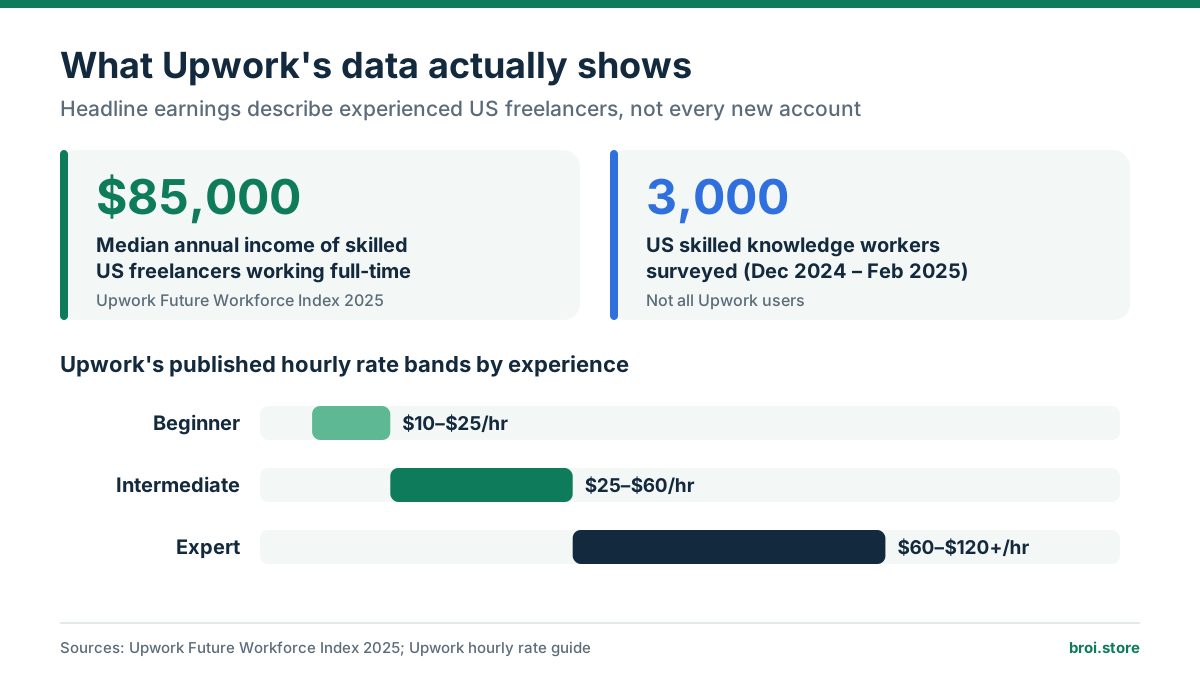
Upwork’s own Future Workforce Index 2025, a survey of 3,000 skilled US knowledge workers, found that skilled professionals who freelance full-time reported a median annual income of $85,000, compared with $80,000 for full-time employees.
Treat that number carefully. It describes skilled, US-based freelancers who already work independently full-time, not everyone who signs up for Upwork. It shows that freelancing can be a serious income for experienced professionals. It doesn’t mean every freelancer earns that much, or that a beginner will get there quickly.
What do freelancers charge on Upwork?
There’s no single standard rate on Upwork. A virtual assistant, a graphic designer, a web developer and an AI consultant can charge very different amounts.
Upwork’s published rate guide gives useful benchmarks by experience level:
| Experience level | Typical hourly rate |
|---|---|
| Beginner (building a profile and first reviews) | $10–$25 |
| Intermediate | $25–$60 |
| Advanced / expert | $60–$120+ |
According to the same guide, administrative and entry-level work typically starts at $10–$25 an hour, while specialised development, AI and consulting work can reach $75–$150 an hour or more.
These are ranges, not promises. Some freelancers charge less and some much more, depending on the service, the client’s needs and their track record. Technical skills tend to command higher rates, but that doesn’t make them the best choice for everyone. Freelancers in writing, design, marketing and admin support build stable businesses too.
What can a beginner realistically earn?
Imagine you’ve learned a skill such as WordPress, graphic design, writing or virtual assistance. You’ve built a profile and a few portfolio samples, and you start applying for jobs at $10 an hour. In your first months you manage to bill 5 hours a week.
| Calculation | Amount |
|---|---|
| Hourly rate | $10 |
| Billable hours per week | 5 |
| Weekly earnings before fees | $50 |
| Monthly earnings before fees (4.33 weeks) | $216.50 |
| Annual earnings before fees, if sustained | $2,600 |
This is an illustration, not a prediction. You may win more work, less work or none at all in your first weeks.
Also, a $10 rate doesn’t mean you earn $10 for every hour you spend freelancing. Writing proposals, improving your portfolio, talking to potential clients and learning new skills are all unpaid. For a beginner, consistent work matters as much as the rate itself.
What if you earn $20 or $30 an hour?
As you complete projects, collect good reviews and specialise, you can usually charge more and bill more hours. Here’s how different combinations translate into monthly income:
| Hourly rate | Billable hours/week | Monthly earnings before fees |
|---|---|---|
| $10 | 10 | $433 |
| $15 | 15 | $974 |
| $20 | 20 | $1,732 |
| $30 | 20 | $2,598 |
| $40 | 25 | $4,330 |
These figures use 4.33 weeks per month and assume you can secure those hours every week. They’re scenarios, not averages from Upwork’s data.
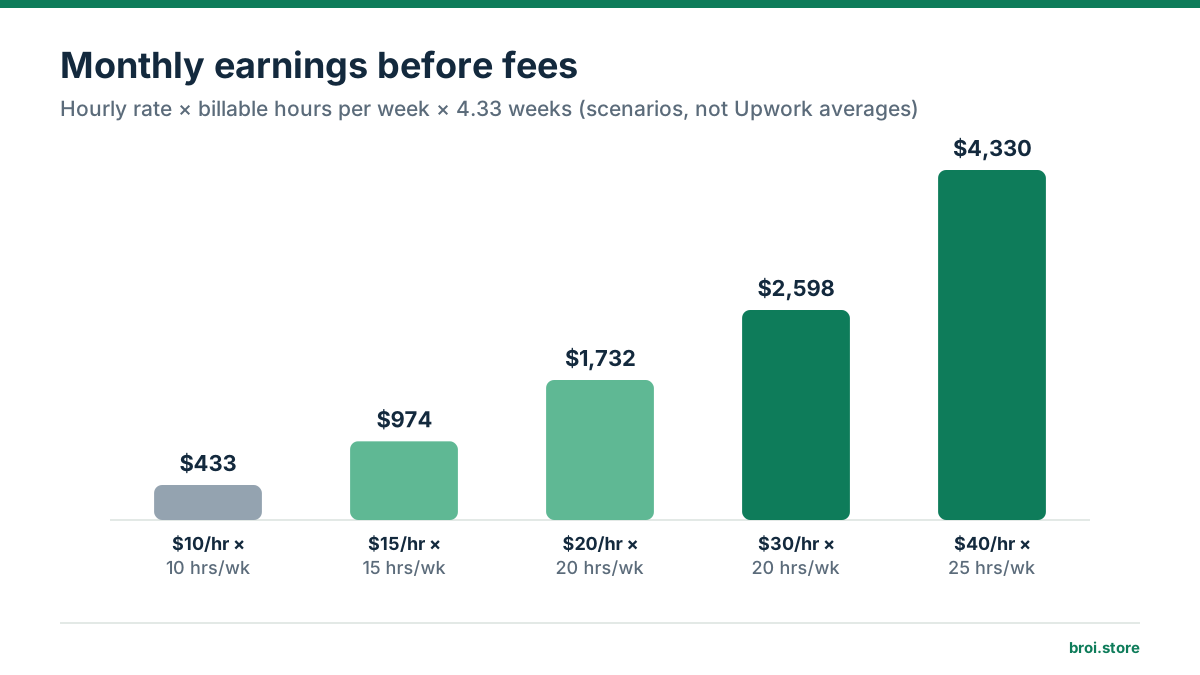
The table shows why two freelancers with similar skills can earn very different amounts. One charges $15 an hour but only gets a few hours a week. Another charges $30 and has reliable repeat clients. A higher rate only helps if clients will pay it and there’s enough work.
How much do you keep after Upwork fees?
Your contract earnings and your take-home pay are not the same. Upwork’s freelancer service fee currently ranges from 0% to 15% per contract. You see the exact fee before you submit a proposal or accept an offer, and it’s locked in once the contract starts.
On a $1,000 project with a 10% fee:
| Item | Amount |
|---|---|
| Contract earnings | $1,000 |
| Upwork service fee (10%) | −$100 |
| Remaining after platform fee | $900 |
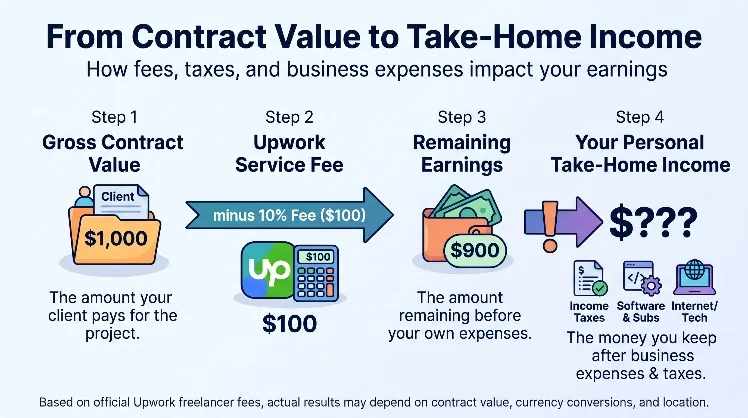
The $900 still isn’t your final take-home. You may also pay for Connects, withdrawals, currency conversion, taxes, internet and software. We break down every cost in Upwork Fees Explained, and the Freelance Take-Home Pay Calculator shows the full chain from contract value to the rupees that reach your bank.
Do Pakistani freelancers earn well on Upwork?
Freelancing is attractive in Pakistan because it connects skilled people with clients abroad. Pakistan’s freelancers earned a record $1.76 billion in export income in FY2025-26, up 78% from the year before, according to the Finance Ministry. But a national total says little about what one person earns.
A more useful source is an August 2026 study by the Mahbub ul Haq Research Centre at LUMS, which analysed profile data from more than 16,000 Pakistani freelancers on Upwork and Freelancer.com. Its main findings:
- Skill category matters a lot. Accounting & consulting, software development and web development averaged roughly $30,000–$35,000 in total lifetime platform earnings. After controlling for other factors, software development earned 46% more than the design & creative baseline, and web development 40% more.
- Track record matters even more on Upwork. Each 0.1 increase in Job Success Score was associated with about 37% higher total earnings.
- There’s a gender gap. Women’s total earnings were about 20% lower after controls; men charged about $19 an hour on average versus about $16 for women.
- Location surprised the researchers. Freelancers in many smaller cities, such as Abbottabad, Attock and Jhelum, out-earned those in Karachi.
One important limitation: the study measured total earnings shown on profiles, built up over each freelancer’s whole time on the platform. These aren’t annual or monthly salaries, and they don’t mean every developer will out-earn every designer or writer.
For a freelancer in Pakistan, the practical lesson is to focus on a service clients value, build a portfolio that proves your skills, protect your Job Success Score and learn to communicate well with international clients. Simply opening an Upwork account is not enough.
Why some freelancers earn much more than others
Two freelancers can have the same technical skills and very different incomes. Here’s why.
1. They solve different problems
Clients pay for results, not just hours. A developer who fixes a critical bug on a business website can charge more than someone offering basic updates. A marketer who can show that a campaign increased sales is worth more to a client than someone who only executes tasks. Specialising makes your value easier to explain.
2. They have different levels of demand
One freelancer charges $30 an hour but bills only 5 hours a week ($150). Another charges $20 and bills 25 hours ($500). The second earns more than three times as much despite the lower rate. Look at both your rate and how much paid work you can reliably get.
3. They spend different amounts of time finding work
Freelancing involves much more than finishing projects. If more of your time goes into finding work than doing it, your effective hourly income can fall well below your profile rate.
4. They build long-term client relationships
Repeat clients make income more predictable. Once a client trusts you, you spend less time competing for new jobs and more time on paid work.
5. They price carefully
Charging too little makes it hard to cover unpaid time and costs. Charging too much without a portfolio to back it up makes contracts harder to win. Check prices in your category, be honest about your experience and raise your rates as your results improve. Our guide on How to Calculate Your Freelance Hourly Rate shows how.
How to estimate your own Upwork earnings
Instead of relying on someone else’s income screenshot, work out your own situation with three questions:
- What hourly rate can I realistically charge at my current skill level?
- How many hours a week can I reliably bill?
- What platform fees and other costs will be deducted?
For example, at $20 an hour for 15 hours a week, your monthly contract income is about $1,299 ($20 × 15 × 4.33). With a 10% fee, about $1,169 remains before taxes and other costs.
That’s a far more realistic estimate than assuming a full-time salary just because you set a particular hourly rate.
Frequently asked questions
Can beginners make $1,000 a month on Upwork?
It’s possible but not guaranteed. At $20 an hour, you’d need about 50 billable hours a month to gross $1,000, and slightly more to cover fees. The real challenge for beginners is winning paid work consistently.
Is $10 an hour a good starting rate?
It can be a reasonable start in some categories, depending on your skills and the market. Make sure it still covers your costs and unpaid time, and review it as your experience and demand grow.
Does Upwork guarantee work or a monthly income?
No. Upwork connects clients and freelancers but doesn’t guarantee you’ll win projects or earn a fixed amount. Your earnings depend on the contracts you secure and complete.
Does Upwork charge a fee on every project?
Upwork charges a freelancer service fee of 0% to 15% per contract. Check the fee shown before you submit a proposal or accept an offer.
Which skills earn more on Upwork?
Upwork’s rate guides and its 2026 in-demand skills research show higher rates and fast growth in specialised technical and AI-related work, software development and data. See Highest-Paying Freelancing Skills in 2026 for the details. Your earnings still depend on experience, demand and the quality of your work.
How long does it take to start earning on Upwork?
There’s no fixed timeline. Some freelancers win a project quickly; others spend weeks or months building their profile and sending proposals. Treat early results as something to build on rather than expecting instant income.
Final thoughts
Freelancers on Upwork earn anything from occasional side income to a substantial full-time living. Published rate guides show beginners starting lower and experienced specialists charging much more, and research confirms that a high income is possible.
But a headline income isn’t the same as what you take home. If you’re new, focus on a marketable skill, a strong portfolio, well-matched projects and positive feedback. A realistic first milestone isn’t thousands of dollars a month. It’s winning one paid project, delivering it well and building from there.
Want to see what you’d keep from your next contract? Try the Freelance Take-Home Pay Calculator.
Sources
- Upwork: Future Workforce Index 2025 (press release, April 2025)
- Upwork: Hourly rates by skill and experience
- Upwork Help: Freelancer service fee
- LUMS Mahbub ul Haq Research Centre: Skills, Cities and Gender: What Affects Freelance Earnings in Pakistan (August 2026)
- Arab News: Pakistan records $1.76 billion freelancer export earnings in FY2025-26 (July 2026)
Run your own numbers
Platform fee, withdrawal, exchange rate and tax in one place, from the client's dollars to the rupees in your bank.
Open the Freelance Take-Home Pay Calculator