How to Write a Freelance Proposal That Gets Replies
A five-part structure for freelance proposals that get replies on Upwork and elsewhere, with a full beginner example and the mistakes to avoid.
In this guide
- Understand the job before you write
- Start with a relevant opening
- Explain how you’ll do the work
- Show relevant work instead of making big claims
- Ask one useful question
- Keep it short and professional
- A beginner proposal example
- Mistakes that reduce your chances of getting replies
- What to do when clients don’t reply
- Frequently asked questions
- Final thoughts
Sending proposals is central to finding freelance work, especially on platforms like Upwork. You might have the right skills, a good portfolio and a professional profile, but if your proposal doesn’t explain why you’re right for this project, the client will simply move on to the next freelancer.
Proposals also cost money. On Upwork, most applications use Connects, which cost $0.15 each beyond your free monthly allowance. Every proposal that gets ignored is time and money lost (see Upwork Fees Explained).
Many beginners make the same mistake. They write a long introduction about themselves, list their skills and ask the client for a chance. The problem is that clients care far more about their own project than about your background. A strong proposal shows that you understand what the client needs, can handle the work and have a sensible plan to deliver it.
Understand the job before you write
Read the whole job description before applying. Don’t start writing after reading only the title. Look for the details that tell you what the client actually needs:
- What’s the main task?
- What problem are they trying to solve?
- Which skills and tools are required?
- What’s the deadline?
- Did they share examples or references?
For example, a client might post a job asking for a WordPress redesign. Reading closely, you see they also want a faster site, a better mobile layout and an improved homepage.
A proposal that only says “I am an experienced WordPress developer” doesn’t address any of that. A better proposal talks about the redesign, the mobile experience and the speed improvements. The closer your proposal matches the job, the more relevant it feels.
Start with a relevant opening
The first few lines of your proposal decide whether the client keeps reading. Often they’re all the client sees in the list of applicants. Avoid generic openings like:
- “Dear Sir, I am writing to apply for this job.”
- “I am a hard-working, passionate freelancer.”
- “I have many years of experience in this field.”
None of these explains why you’re a good fit. Start with something specific to the project instead:
“You want your website redesign to improve both the mobile experience and page loading speed. I can update the layout while keeping it consistent with your existing content and brand style.”
That opening shows you’ve read the job and understood what the client wants.
Explain how you’ll do the work
Clients want to know what happens after they hire you. Briefly describe how you’ll approach the project.
- For an article: you’ll study the target audience, research the topic, create an outline and deliver an original article that meets the brief.
- For a website project: you’ll review the existing site, identify the changes needed, implement them and test the pages on mobile and desktop.
You don’t need to explain every technical detail. A short, clear plan is more useful than a long description of your whole process.
Show relevant work instead of making big claims
A portfolio sample is more convincing than any claim. Instead of telling the client you’re an expert, show them something that proves it.
- For a design job, share a relevant design sample.
- For a writing job, share an article in a similar style.
- For a website job, share a site or project you built.
Choose samples that match the client’s request. Sending five unrelated links makes your application look unfocused.
If you’re a beginner without paid work, you can share projects you created yourself. Just be honest that they’re sample projects, not paid client work.
Ask one useful question
A thoughtful question can start a conversation, and it shows you’re thinking about the project rather than sending a copied message. For example:
- “Do you already have a design reference, or would you like me to suggest a layout?”
- “Should the articles follow an existing brand tone, or would you like me to develop one?”
- “Do you have a preferred platform for the online store?”
Don’t ask something the job description already answers. Your question should clarify something that genuinely matters.
Keep it short and professional
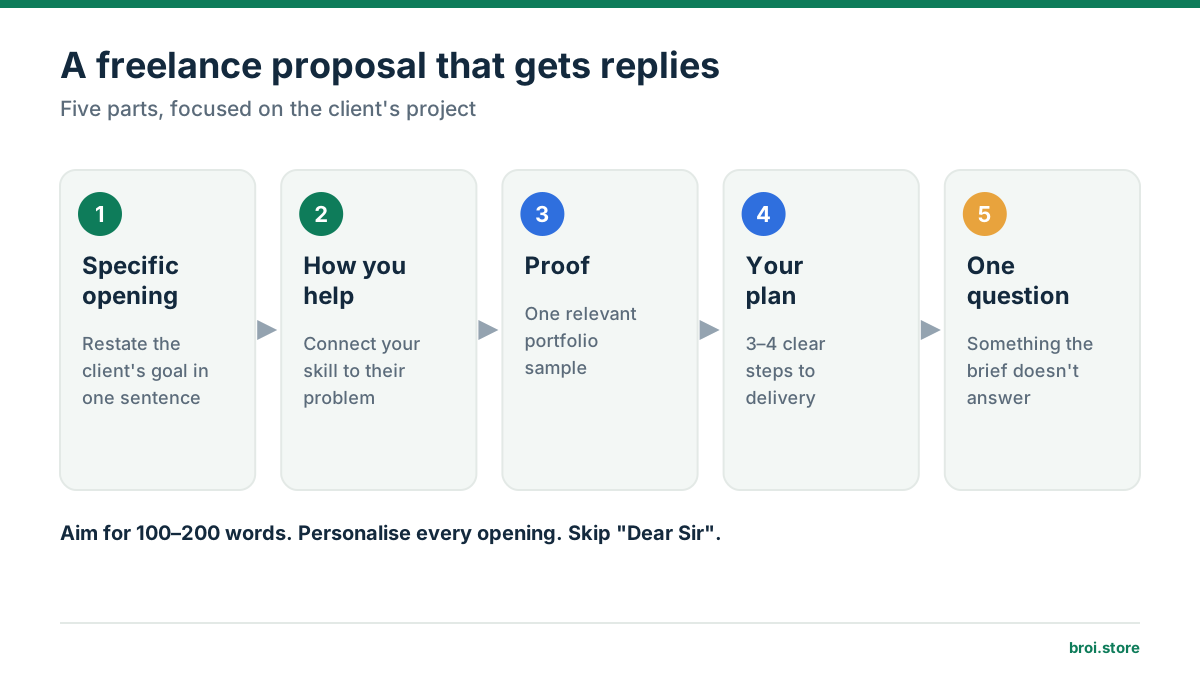
Proposals don’t need to be long. Clients may receive many applications, so make yours easy to read. A practical structure:
- A project-specific opening
- A short explanation of how you can help
- A relevant portfolio sample or proof of skill
- A brief summary of the work you’ll do
- A useful question or a simple invitation to discuss the project
Don’t repeat your entire profile. Your profile already has your background; use the proposal to explain why you’re right for this job.
A beginner proposal example
Suppose you’re applying for an Upwork project where the client wants their WordPress website redesigned. Here’s a simple proposal:
Project: WordPress Website Redesign
Hi,
I’ve read your project description. You’d like your WordPress website to look cleaner and more professional, with a better experience on mobile.
I can redesign your pages with a refreshed layout and make sure the site works smoothly on desktop, tablet and mobile.
My approach: review your current site, list the changes needed, update the design, then test every page before delivery.
Here’s a similar site I built: [your relevant portfolio link]
Do you have a reference website or design style in mind? I’d be happy to discuss your requirements and suggest the best approach.
Thank you, [Your name]
This example is deliberately simple. Adapt it to each client’s actual requirements instead of copying it for every job.
Mistakes that reduce your chances of getting replies
Even a well-written proposal won’t win every job. Clients weigh budget, experience, availability and fit. But avoid the mistakes that make your application less convincing:
- Sending the same proposal to everyone. Generic applications rarely show you understand a specific project. Personalise the opening and connect your skills to the client’s needs.
- Writing too much about yourself. Your qualifications matter, but the client mainly wants to know how you’ll help with their project.
- Making unrealistic promises. Don’t guarantee first-page Google rankings, overnight delivery or complex work you can’t do.
- Applying for unrelated jobs. Proposals for projects outside your skills waste time and Connects, and can hurt your reputation.
- Ignoring client instructions. Some clients ask applicants to answer specific questions or include a keyword. Follow those instructions carefully.
- Competing only on price. The lowest bid isn’t automatically the best candidate. Show value and understanding instead. Know your minimum rate first using the Freelance Hourly Rate Calculator.
What to do when clients don’t reply
Not hearing back is a normal part of freelancing, especially when you’re new. It doesn’t always mean your proposal was bad. Review the jobs you applied for:
- Did they match your skills?
- Did your opening address the client’s requirements?
- Did you include a relevant sample?
- Was your price realistic for the work?
Keep improving your portfolio, and apply for projects with clear requirements. Track your applications and replies so you can spot patterns over time.
A few well-targeted proposals beat dozens of unfocused ones.
Frequently asked questions
How long should a freelance proposal be?
Short enough to read in under a minute: usually 100 to 200 words. Focus on the client’s needs, your plan, one relevant sample and a question.
Should I mention my price in the proposal?
On Upwork you set your bid separately, so the proposal text should focus on value. If you mention price, explain briefly what’s included so the client understands what they’re paying for.
Is it okay to use a proposal template?
Use a structure, not a copy-paste message. Clients can spot generic proposals instantly. Always personalise the opening and the plan for each job.
How many proposals should I send per day?
Quality matters more than quantity. A few carefully tailored proposals for well-matched jobs usually get better results, and use fewer Connects, than dozens of generic ones.
Final thoughts
Writing a freelance proposal that gets replies comes down to understanding the client’s needs and communicating your value clearly. You don’t need fancy language or an impressive list of qualifications. You need a relevant opening, a practical plan, proof of your skills and professional communication.
Sources
Run your own numbers
Platform fee, withdrawal, exchange rate and tax in one place, from the client's dollars to the rupees in your bank.
Open the Freelance Take-Home Pay Calculator