How to Start Freelancing in Pakistan With Zero Experience
A realistic plan to start freelancing in Pakistan with no experience: pick one skill, build a portfolio, set up profiles, win a first client and get paid.
In this guide
- Start by choosing one skill
- Learn enough to deliver a real service
- Build a portfolio before your first client
- Create your freelancing profiles
- How to find your first client
- Price your first projects sensibly
- Getting paid as a freelancer in Pakistan
- Your first 30 days
- Frequently asked questions
- Final thoughts
Starting freelancing in Pakistan with zero experience can feel impossible when you have no portfolio, no past clients and no professional work history. But you don’t need years of experience to begin. You need a skill clients will pay for, a few examples of your work and the ability to communicate clearly with potential clients.
Many beginners make the same mistake: they create Upwork and Fiverr accounts on day one and wait for orders to arrive. Freelancing doesn’t work like that. Clients want to see what you can do before they trust you with a project, so preparation makes a big difference.
Start by choosing one skill
The first step is deciding which service you’ll offer. You don’t need to learn everything at once. Pick one skill that suits your interests, available time and ability to learn.
Beginner-friendly options include:
- Content writing: blog posts, web pages and product descriptions.
- Graphic design: social media posts, banners, thumbnails and simple marketing materials.
- Video editing: short-form videos, YouTube Shorts, Reels and promotional clips.
- WordPress development: building websites, editing pages and managing site content.
- Virtual assistance: research, data entry, email management and admin tasks for businesses.
- Social media management: planning posts, writing captions, creating graphics and running business accounts.
Also ask whether businesses actively pay for the skill you want to learn. A skill can be interesting, but it’s far more useful when clients clearly need it. Upwork’s 2026 demand data, covered in Highest-Paying Freelancing Skills in 2026, is a good reality check.
Learn enough to deliver a real service
You don’t need an expensive course to start. Free learning materials on YouTube, educational websites and software documentation can teach you the practical basics.
But watching tutorials isn’t the same as being able to do the work. Practise on your own small projects:
- Learning content writing? Write several complete articles.
- Learning graphic design? Design social media posts for imaginary businesses.
- Learning WordPress? Build a simple website from start to finish.
Your goal is to reach the point where you can confidently complete a small client project without relying on someone else.
Build a portfolio before your first client
A portfolio is proof of your ability. The good news is that you don’t need a paid project to build one.
Create samples based on realistic business needs. Write a homepage for a restaurant, product descriptions for an online shop or a short promotional video for an invented brand. Make sure your samples match the service you want to sell. A portfolio full of unrelated work makes it hard for clients to see what you actually offer.
You can display your work on a simple portfolio website, a Google Drive folder, a Behance profile or whichever platform suits your skill. Always be honest that samples are practice work, not paid client projects.
Create your freelancing profiles
Once you have a skill and a few portfolio samples, set up profiles on freelance platforms.
- Upwork is mainly used for applying to jobs posted by clients. You read job descriptions, send proposals and explain why you’re a good fit.
- Fiverr works differently: you create service listings called Gigs, and buyers find and order them.
You can also find work through LinkedIn, professional groups, Facebook communities and direct contact with businesses. Each platform has different fees, compared in Upwork vs. Fiverr vs. Freelancer.com Fees.
Your profile should clearly explain:
- What service you provide
- What kind of client you help
- What problems you solve
- What relevant experience or samples you have
Avoid saying you can “do anything”. A focused profile makes it much easier for clients to understand what you offer.
How to find your first client
Your first client is often the hardest part of freelancing. Instead of sending the same message to dozens of people, look for projects that match your current abilities.
Read the whole job description, understand what the client needs, explain how you’d approach the project and include a matching portfolio sample. Our guide to How to Write a Freelance Proposal That Gets Replies shows exactly how.
You can also contact small businesses directly. If you design websites, look for local businesses with outdated or hard-to-use sites and send a professional message suggesting one or two specific improvements.
Never promise results you can’t guarantee. Building trust is worth more than making unrealistic promises to win a project.
Price your first projects sensibly
Beginners often charge too little, or copy someone else’s price without knowing whether it covers their time. Even at the start, work out what you need to earn. Upwork’s rate guide shows beginners typically charging $10–$25 an hour. The Freelance Hourly Rate Calculator helps you find a rate that covers your costs and unpaid time.
Getting paid as a freelancer in Pakistan
Before you take on international work, know how you’ll receive payments. Depending on the client and platform, you may be paid through Upwork’s Direct to Local Bank option, Payoneer or a direct bank transfer. Note that PayPal isn’t available in Pakistan.
Check availability, withdrawal methods, exchange rates and fees before choosing. See How to Receive Freelance Payments in Pakistan for a full comparison.
Keep records of invoices, client payments, platform reports and bank transactions from day one. You’ll also need to understand your tax obligations. Freelance export income is taxed at low rates in Pakistan, but it isn’t tax-free (see Do Freelancers in Pakistan Pay Income Tax?). Organise your records from the start rather than waiting until your income is substantial.
Your first 30 days
A simple routine stops you from spending months learning without taking action.
| Week | Focus |
|---|---|
| Week 1 | Choose your skill and understand the services clients buy. |
| Week 2 | Learn the fundamentals and complete practice exercises. |
| Week 3 | Create 3–5 strong portfolio samples and set up your profile. |
| Week 4 | Start applying for suitable projects, contact potential clients and refine your proposals. |
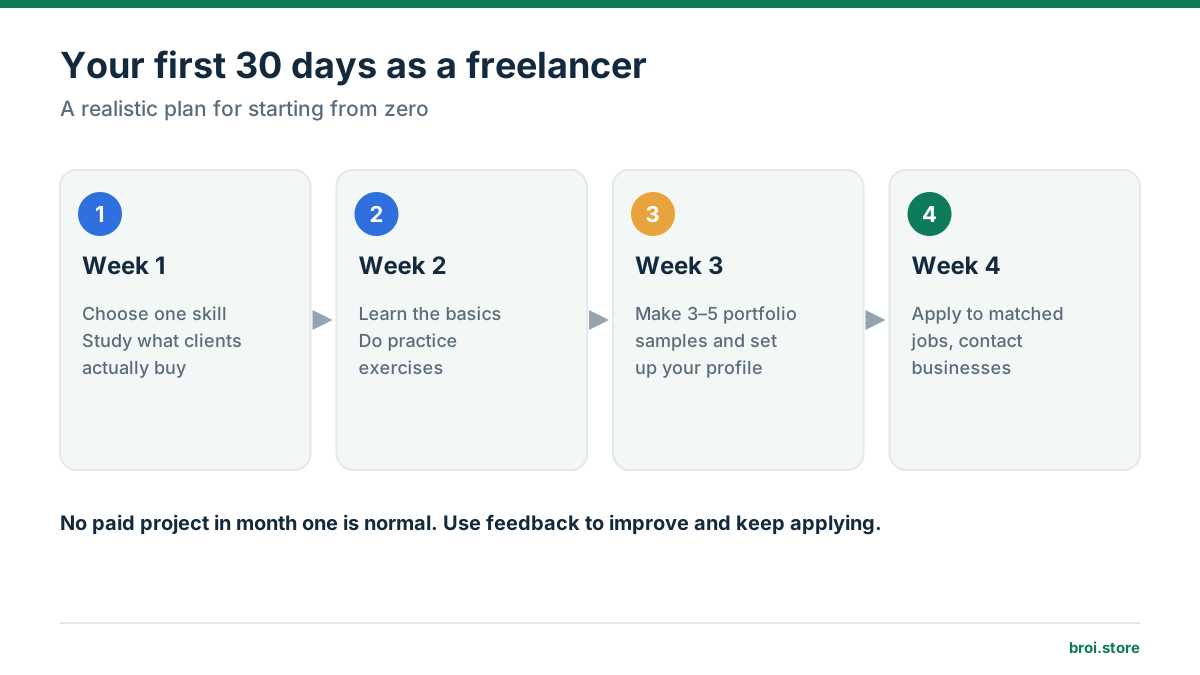
You might not land a paid project in your first month. That doesn’t mean freelancing won’t work for you. Use the feedback to improve your skills, portfolio and communication, and keep going.
Frequently asked questions
Can I start freelancing with no experience?
Yes. You don’t need professional experience, but you do need a marketable skill and a few portfolio samples that prove you can do the work.
Which skill is easiest to start with?
There’s no single easiest skill. Content writing, graphic design, video editing, WordPress, virtual assistance and social media management are all realistic starting points. Pick one that matches your interests and that businesses pay for.
How long does it take to get the first client?
It varies. Some beginners win a project within weeks; others take a few months. Applying to well-matched jobs with tailored proposals speeds it up.
Should I start on Upwork or Fiverr?
Upwork suits people comfortable writing proposals for posted jobs; Fiverr suits people who can package their skill into fixed services. Many beginners try one first, then add the other.
Final thoughts
You can start freelancing in Pakistan with zero experience, but it takes preparation and consistency. You don’t need to be an expert. Focus on getting good at one service, showing proof of your work and communicating professionally.
Your first goal shouldn’t be to earn a lot of money quickly. It should be to complete one project, make one client happy and gain experience that leads to better opportunities.
Sources
Run your own numbers
Turn your income goal, expenses, tax and billable hours into a minimum and target hourly rate.
Open the Freelance Hourly Rate Calculator